MPSC ATP: 148 recommended in revised list, next advertisement awaited
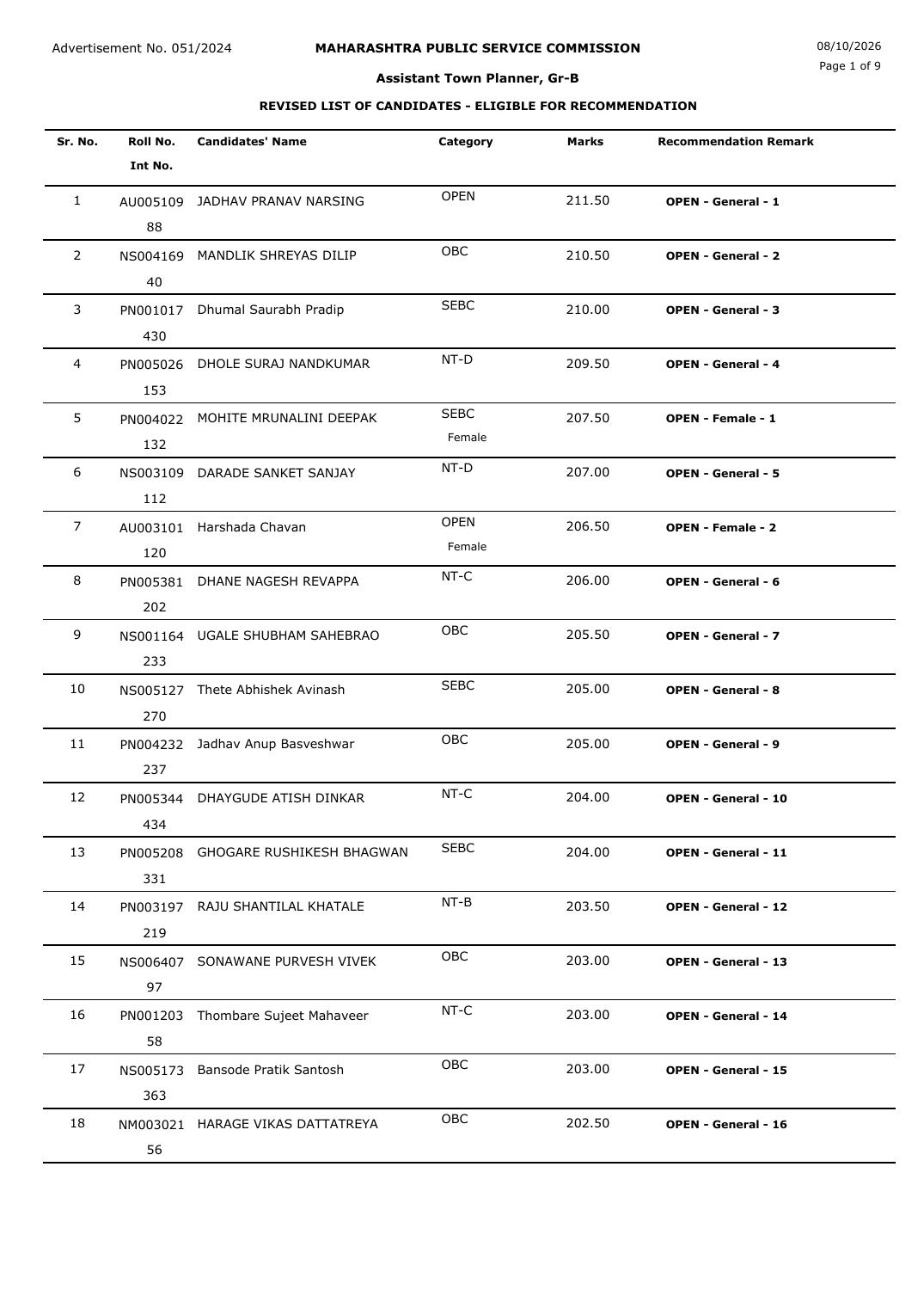
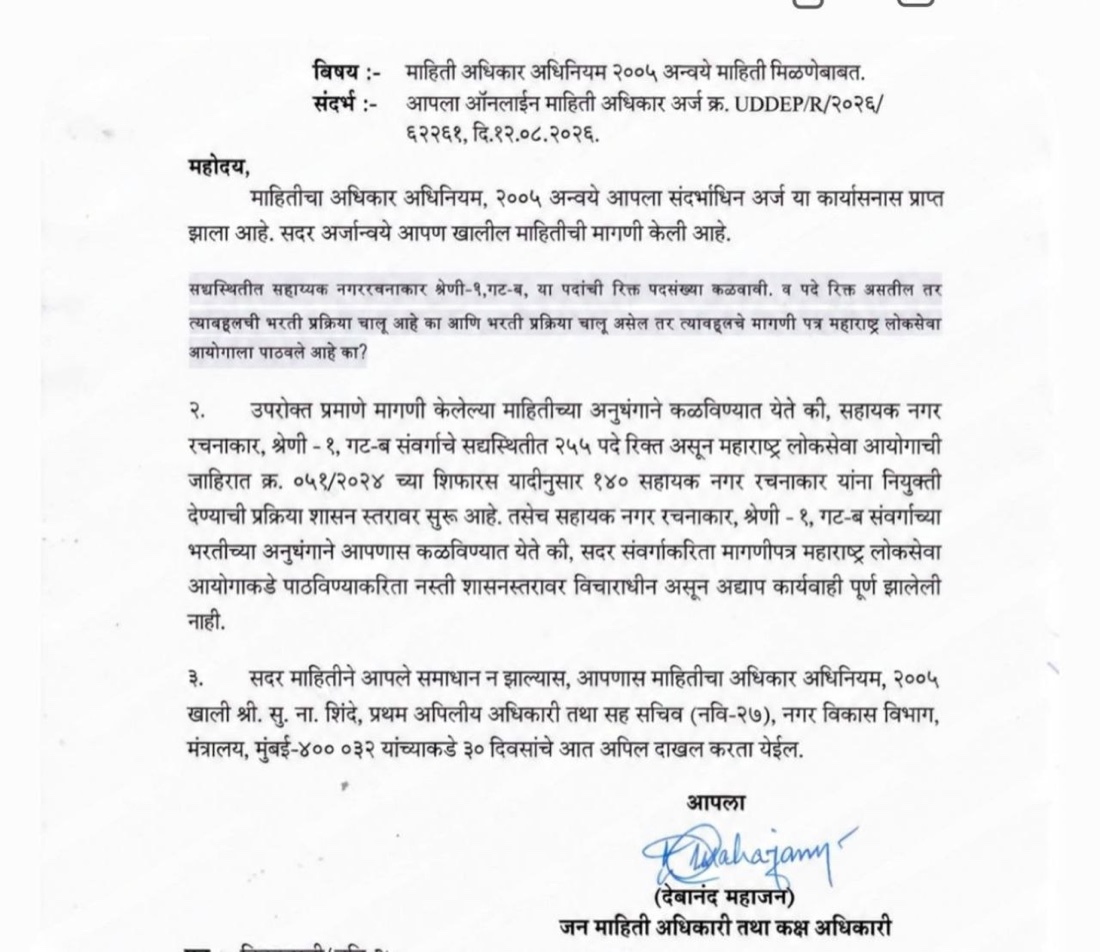
MPSC published the revised recommendation list (Advt. 051/2024, 8 Oct 2026). RTI reply: 255 posts vacant, requisition not yet sent to the MPSC. Notification date and exam date are unannounced. Use this window to build your base.
Official RTI Reply
MPSC Assistant Town Planner (Group-B): 255 Vacant Posts, Requisition Not Yet Sent to MPSC — RTI Reply
Watch: how to start MPSC ATP 2027 preparation — see batch details & enrol
Quick answer: The MPSC ATP syllabus has 19 topics. Six of them (Regional Plan, Development Plan, Town Planning Scheme, Local Area Plan, UDCPR, Development Charges and Appeal) are about how plans are made and enforced under the MR&TP Act 1966. Four more are valuation and land acquisition. Below is the full list (the last exam's syllabus, 2024, which is the probable 2027 syllabus), with a study order for Civil Engineering and Architecture graduates.
Probable MPSC ATP 2027 syllabus: all 19 topics
| # | Topic | Key sub-topics |
|---|---|---|
| 1 | Current Events and Technology | National and international events (industrial, economic, spatial planning, urban development); Total Station, Drone, Remote Sensing, GIS, GPS and Computer-Aided Design in urban planning |
| 2 | Urbanisation, Govt. Schemes and Missions | Salient features of Indian urbanisation with reference to Maharashtra and its challenges; AMRUT, Shyama Prasad Mukherjee Rurban Mission, Pradhan Mantri Awas Yojana, Smart City |
| 3 | Policies in India and Maharashtra | National Urban Transport Policy, National Land-utilisation Policy, National Housing Policy |
| 4 | RTI and RTS Acts | Right to Information Act, Right to Services Act |
| 5 | Theories of Planning | Garden City, Geddian Trio, Concentric Zone, Sector Theory, Multi-nuclei Theory, Neighbourhood Concept |
| 6 | Regional Plan | Need, delineation of region, types of regions, contents, surveys, analysis and projections, preparation under the MR&TP Act 1966, relation with State Plan |
| 7 | Development Plan | Structure Plan vs Development Plan, classification of towns, surveys, demographic projections, goals, public participation, implementation and finance, contents, planning norms, modifications, notices under sections 49 and 127, preparation and approval under the MR&TP Act |
| 8 | Town Planning Scheme | Concept, preparation under the MR&TP Act, relation with DP, original, final and semi-final plot, incremental contribution, contents, cost, advance possession, amenities partially beneficial, Arbitrator, Tribunal of Appeal |
| 9 | Local Area Plan | Concept, objectives, delineation of boundary, methodology, case studies in India, provision in UDCPR |
| 10 | Unified Development Control Regulations (UDCPR) | Development and building permission, deemed permission, risk-based approvals, land development requirements, zone equivalency, P-line, ancillary FSI, TDR, Accommodation Reservation, Reservation Credit Certificate, redevelopment of dilapidated buildings, EWS/LIG housing, green building incentives, off-street parking, affordable housing, voluntary TP schemes, heritage list card, premiums, Integrated Township, Transit Oriented Development |
| 11 | Development Charges and Appeal | Development charges, revocation of permission, appeals under sections 47 and 124, action against unauthorised development |
| 12 | Transportation | Transportation studies, origin and destination, traffic volume survey, modal split, transport system |
| 13 | Environment | Environment Clearance, Environmental Impact Assessment |
| 14 | Acts and Rules | Evolution of planning legislation in India; MR&TP Act 1966 and rules; Maharashtra Municipal Corporations Act 1949; Maharashtra Municipal Councils, Nagar Panchayats and Industrial Townships Act 1965; Maharashtra Land Revenue Code 1966; Environment Protection Act 1986; Bombay Stamp Act 1958; 73rd and 74th Constitutional Amendments |
| 15 | Land Acquisition | Need of compulsory acquisition, functions of the Land Acquisition Officer, RFCTLARR Act 2013 |
| 16 | Valuation | Value, cost, price; purposes of valuation; special characteristics of landed property; supply and demand; interests in land; forms of value and rent; capitalised value; year's purchase; outgoings, depreciation, sinking fund, reversionary value |
| 17 | Valuation Tables | Meaning and utility; amount of Re 1; present value of Re 1; amount of Re 1 per annum; present value of Re 1 per annum; annuity of Re 1; sinking fund; single and dual rate |
| 18 | Methods of Valuation | Comparative method, market approach, contractor's method, investment method, belting method |
| 19 | Annual Statement of Rates | True market value, procedure for preparation of the Annual Statement of Rates, valuation for bulk land |
Exam pattern: MCQ test of 100 questions for 200 marks, then an interview of 50 marks, then selection. This probable syllabus is based on the last exam and will be updated here when the MPSC publishes the latest notification.
What is new for Civil Engineering and Architecture graduates
Direct answer: the legal and valuation topics are the ones most engineering and architecture degrees never covered.
- Planning law (topics 4, 14, 15): the MR&TP Act, municipal acts, Land Revenue Code, Bombay Stamp Act and the 2013 land acquisition law are statute-reading topics. Learn section numbers together with what each section does.
- Plan-making procedure (topics 6 to 9): expect questions on who prepares each plan, how it is published and approved, and the terms of a Town Planning Scheme (original, final, semi-final plot, incremental contribution).
- UDCPR (topic 10): the largest single topic by sub-topics. Concepts such as ancillary FSI, TDR and Reservation Credit Certificate are easier to retain when grouped by purpose.
- Valuation (topics 16 to 19): numerical. Practise year's purchase, sinking fund and valuation-table problems until they are routine.
- Familiar ground: transportation, environment (EIA) and GIS and remote sensing overlap with your degree, so they are quicker to revise.
Suggested study order
- Topics 5 and 14: theories of planning and the Acts, to build the base.
- Topics 6 to 9 and 11: Regional Plan, Development Plan, Town Planning Scheme, Local Area Plan, development charges and appeals.
- Topic 10: UDCPR.
- Topics 15 to 19: land acquisition and valuation, with daily numericals.
- Topics 1 to 4, 12 and 13: current events and technology, schemes and policies, RTI and RTS, transportation, environment.
- Then full-length timed tests until you finish 100 questions comfortably.
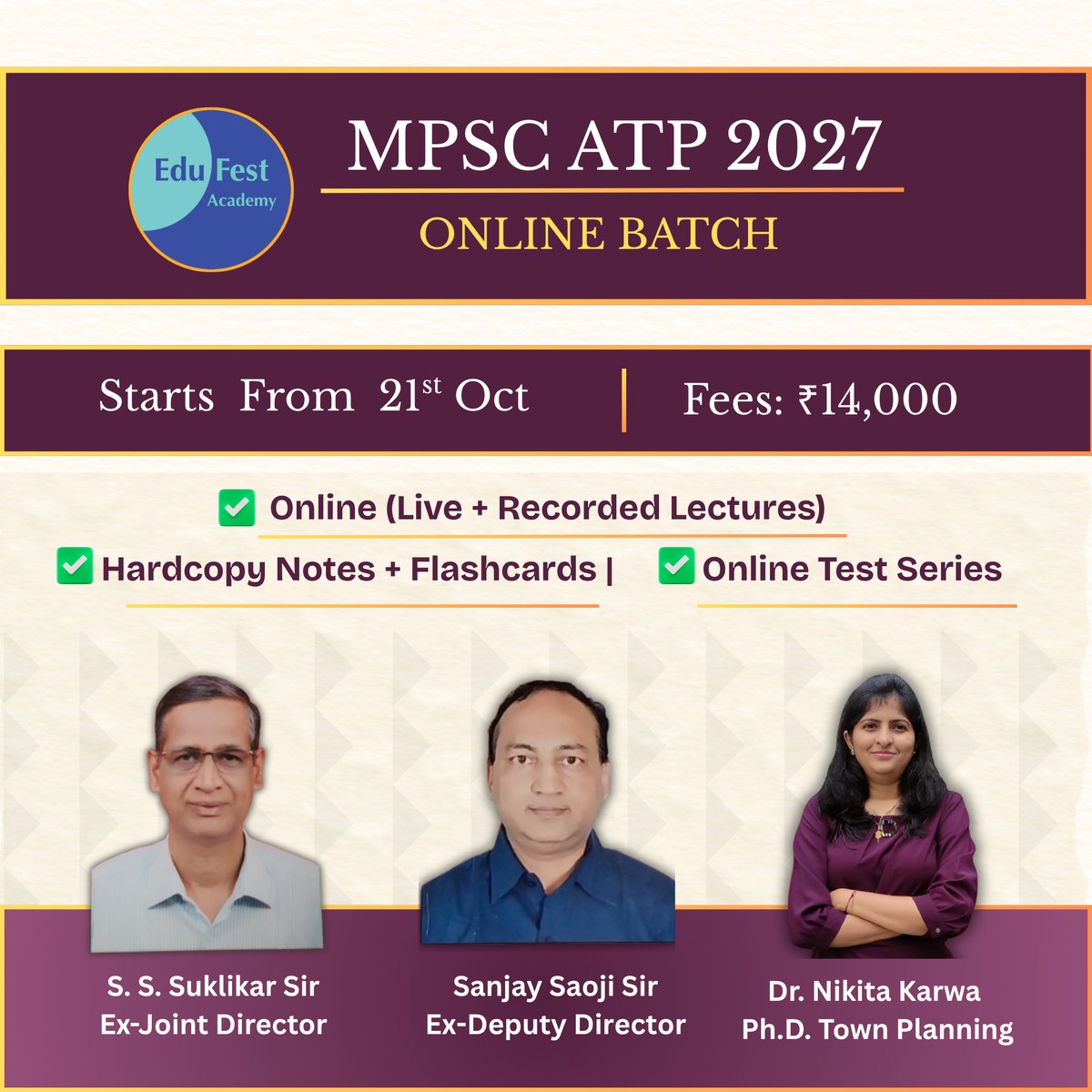
Our faculty teach in this spirit: Dr. Nikita Karwa covers Valuation, MR&TP Act, GIS and the LARR Act; S. S. Suklikar Sir (Ex-Joint Director) covers the MR&TP Act and Regional Plan; Sanjay Saoji Sir (Ex-Deputy Director) covers UDCPR and Development Plan.
See the MPSC ATP 2027 Online Batch →
Frequently Asked Questions (FAQ)
How many topics are in the MPSC ATP syllabus?
The probable MPSC ATP 2027 syllabus (based on the last exam) has 19 topics, from Current Events and Technology to the Annual Statement of Rates.
Which Acts are in the MPSC ATP syllabus?
The MR&TP Act 1966 and rules, Maharashtra Municipal Corporations Act 1949, Maharashtra Municipal Councils, Nagar Panchayats and Industrial Townships Act 1965, Maharashtra Land Revenue Code 1966, Environment Protection Act 1986, Bombay Stamp Act 1958 and the 73rd and 74th Constitutional Amendments, plus the RTI, RTS and RFCTLARR 2013 Acts.
Is valuation part of the MPSC ATP syllabus?
Yes. Valuation, valuation tables, methods of valuation and the Annual Statement of Rates are four of the 19 topics.
Is this the 2027 syllabus?
It is the probable 2027 syllabus: the syllabus of the last MPSC ATP exam (2024). The MPSC has not yet released a new notification, and we will update this page when it does.
What is the MPSC ATP exam pattern?
An MCQ test of 100 questions for 200 marks, then an interview of 50 marks, then selection.
Related resources
- MPSC ATP exam 2027: complete guide
- MPSC ATP 2027 Online Batch
- MPSC Town Planner courses and test series
- MPSC ATP flashcards
- Previous year papers
Source: syllabus of the last MPSC ATP exam (Advt. 051/2024), shown as the probable 2027 syllabus. Verify on the official MPSC website.