TGPSC RECRUITMENT 2026 · TELANGANA
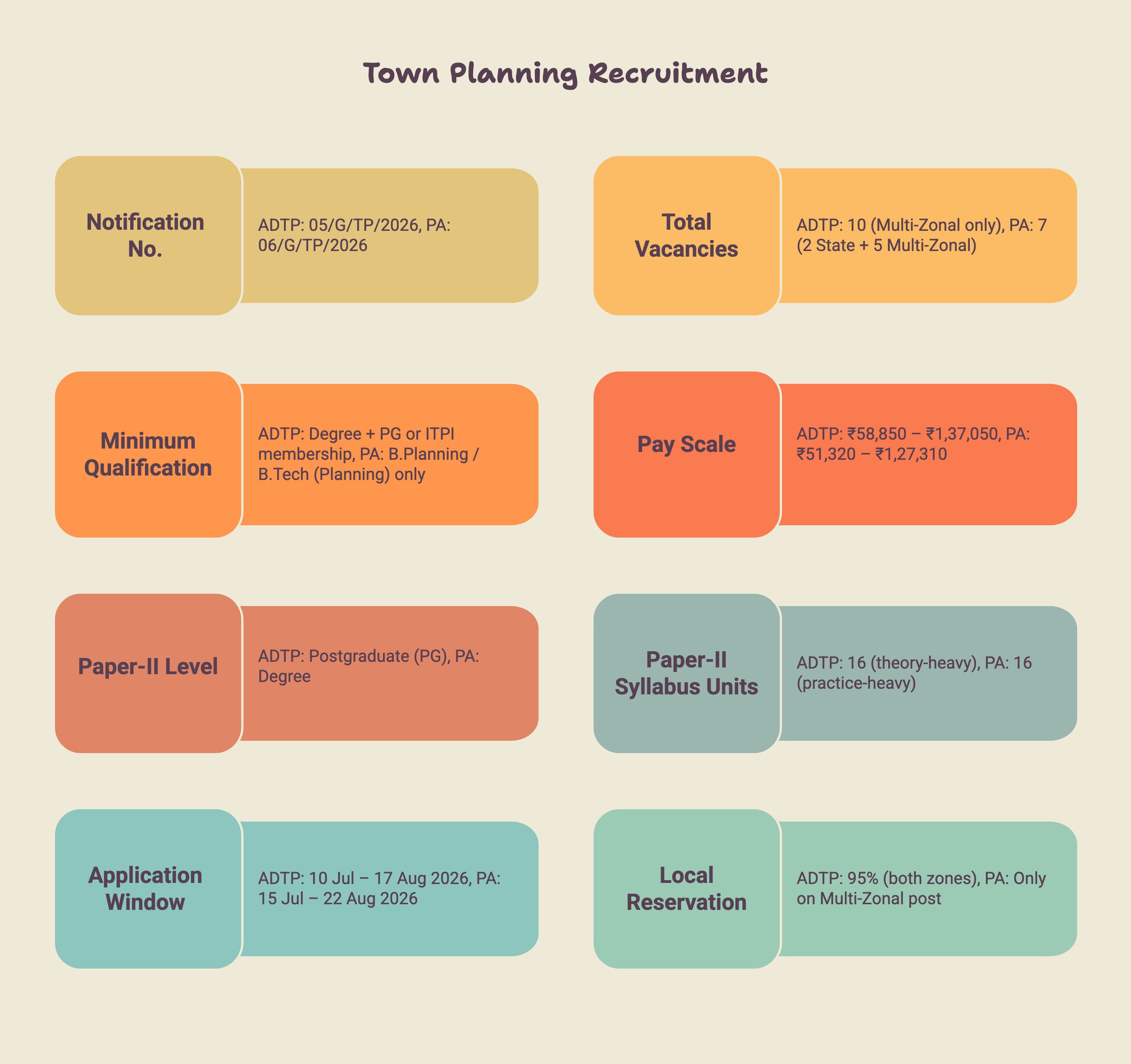
Quick answer: The Telangana Public Service Commission (TGPSC) is recruiting 10 Assistant Directors of Town Planning (ADTP) for the Town and Country Planning Department, Telangana, under Notification No. 05/G/TP/2026 dated 6 July 2026. Applications are open 10 July - 17 August 2026 at tgpsc.gov.in, the exam is tentatively in October 2026, and selection is by a 450-mark objective test in which the Town & Country Planning subject paper carries 300 of those marks. You are eligible if you hold a B.Arch / B.E.-B.Tech (Civil) / B.Planning / M.A.-M.Sc. (Geography) / M.Sc. (Geoinformatics) plus a PG degree or diploma in Town & Country Planning.
| 10ADTP posts | 300Paper-II marks (of 450) | 95%Local reservation | 17 AugLast date to apply |
Who this is for: Town planning, architecture, civil engineering and geography postgraduates in Telangana - especially candidates in and around Hyderabad, Warangal, Karimnagar, Khammam and Nizamabad, the five official exam-centre cities.
TGPSC ADTP 2026 at a glance
| Item | Detail |
|---|---|
| Recruiting body | Telangana Public Service Commission (TGPSC) |
| Post | Assistant Director of Town Planning (ADTP) |
| Department | Town and Country Planning Department, Government of Telangana |
| Notification | 05/G/TP/2026, dated 06/07/2026 |
| Vacancies | 10 (Multi-Zone I: 5, Multi-Zone II: 5) |
| Pay scale | Rs. 58,850 - Rs. 1,37,050 |
| Age (as on 01/07/2026) | 18-44 years (relaxations for SC/ST/BC/EWS/PwD/Ex-SM) |
| Application window | 10 Jul 2026 - 17 Aug 2026 (5:00 PM) |
| Exam date | October 2026 (tentative) |
| Mode | Online only, via tgpsc.gov.in |
| Exam centres | Hyderabad (incl. HMDA area), Karimnagar, Khammam, Warangal, Nizamabad |
| Local reservation | 95% (Multi-Zonal post) |
| Total marks | 450 (GS 150 + Subject 300) |
Am I eligible for TGPSC ADTP 2026? Eligibility criteria explained
Direct answer: you need two qualifications, not one. You must hold both a base degree and a postgraduate qualification in town planning, as on the notification date (06/07/2026).
1. A base degree - any ONE of:
- B.Arch
- B.E. / B.Tech (Civil)
- B.Planning / B.Tech (Planning)
- M.A. (Geography) or M.Sc. (Geography)
- M.Sc. (Geoinformatics)
2. AND a postgraduate qualification in town planning - any of:
- PG Degree or PG Diploma in Town & Country Planning from a recognised Indian university, or
- Associateship / Fellowship of the Institute of Town Planners of India (ITPI), or an equivalent recognised by the UGC.
Age: 18-44 years as on 01/07/2026 (born between 02/07/1982 and 01/07/2008). SC/ST/BC/EWS get +5 years; PwD +10; Telangana government employees up to +5.
The eligibility trap most people miss: a B.Arch or Civil degree alone is not enough - the PG in Town & Country Planning is mandatory. Conversely, a Geography/Geoinformatics PG plus a town-planning PG does qualify, which many geography graduates do not realise. (Distance/open-university degrees must be UGC/AICTE/DEB-recognised.)
Why the subject paper decides your selection
Direct answer: Paper-II is worth twice Paper-I, so your rank is effectively decided by town-planning subject knowledge - not general studies.
| Paper | Subject | Questions | Marks | Language |
|---|---|---|---|---|
| Paper-I | General Studies & General Abilities | 150 | 150 | English & Telugu (bilingual) |
| Paper-II | Town & Country Planning (PG level) | 150 | 300 | English |
- Paper-II is 66.7% of the total marks. Two candidates with identical GS scores are separated almost entirely by the subject paper.
- With only 10 posts, clearing the qualifying cut-off is not enough. Qualifying marks are OC/EWS/Sports 40%, BC 35%, SC/ST/PwD 30% - but selection is strictly by merit rank against the 10 seats.
- For multi-session computer-based tests, TGPSC normalises scores on a percentile basis, so raw marks can shift - consistency across the full paper matters more than a few lucky questions.
Takeaway for Telangana aspirants: generic UPSC/GS coaching will not move your rank here. Deep command of the 16-unit town-planning syllabus will.
TGPSC ADTP Paper-II syllabus (16 units) - with high-yield Telangana focus
Direct answer: the Paper-II syllabus spans 16 units from planning theory to disaster management; the highest-yield, most Telangana-specific area is planning legislation.
- Settlement Evolution & Planning Theory
- Planning Analysis & Techniques (surveys, census, URDPFI guidelines, zoning)
- Socio-Economic Base for Planning
- Planning Process (structure vs development/master plan, RS & GIS)
- Infrastructure Planning (water, sewerage, solid waste)
- Traffic & Transportation Planning (TOD, BRT, Metro, Comprehensive Mobility Plan)
- Housing & Community Planning (NBC 2016, PPP, affordable housing)
- Metropolitan & Regional Planning (Christaller, rank-size rule, growth centres)
- Urban Information Systems & Spatial Analysis (GIS, remote sensing, Bhuvan)
- Environmental Planning (EIA, sustainability, climate adaptation)
- Urban Governance & Management (74th CAA, MPCs/DPCs, RTI)
- Planning Legislation & Professional Practice
- Urban Design, Conservation & Landscape Design
- Project Planning & Appraisal (PERT/CPM, IRR, NPV)
- Risk, Disaster Mitigation & Management
- Current Planning Trends (Smart Cities, AMRUT, TOD, PMAY)
Full TGPSC Paper-II topic list (searchable revision index)
Direct answer: below is the topic-level breakdown of those 16 units - the exact headings you'll be tested on, so you can search and revise any single concept.
Planning theory & history of town planning: objects and principles of town planning; Ebenezer Howard's Three Magnets and Garden City; Letchworth and Welwyn Garden Cities; Sir Raymond Unwin and satellite towns; Sir Patrick Geddes (Father of Town Planning); Clarence Perry's Neighbourhood Unit concept; Concentric Zone, Sector and Multiple-Nuclei theories; Lewis Mumford and C.A. Doxiadis (Ekistics); Indus Valley / Harappan town planning, Mohenjo-Daro (Great Bath, Granary) and Harappa's drainage system; Shilpa Shastra town forms - Dandaka, Sarvatobhadra, Nandyavarta, Padmaka, Swastika and Prastara; Edwin Lutyens' Delhi, Chandigarh (Albert Mayer and Le Corbusier) and Jaipur.
Planning process & techniques: perspective, regional, development, master and local area plans; URDPFI guidelines and land-use zoning; contents and GIS-based process flow of a Development Plan; population forecasting - arithmetical, geometrical, incremental and logistic-curve methods; primary and secondary surveys; socio-economic, land-use and density surveys; mapping and scale of map; Town Planning Scheme, land pooling and reconstitution; Rajasthan Land Pooling Scheme Act 2016.
Region, infrastructure & transportation: classification of urban settlements; formal and functional regions; regional plan contents, SWOT and delineation of regions; land-use zones (U, I, T, PA, O, E, S); urban agglomeration, conurbation, umland, primate city and rank-size rule; water supply and demand (domestic, fire-fighting, institutional, industrial), sewerage, sanitation and solid-waste management; planning standards and social infrastructure norms; traffic volume, speed, origin-destination, parking and accident studies; PCU; four-stage transport model, modal split and travel-demand forecasting; BRTS, RRTS and public-transport integration.
Housing, environment & disaster management: housing need, demand, supply and shortage; housing typologies, development process and finance; houselessness and night shelters (Census 2011); Environmental Impact Assessment (EIA) process and 2006 amendments; Eco-Sensitive Zones and the Coastal Regulation Zone (CRZ); climate-change causes and impacts; Disaster Management Act 2005 and NDMA; National Disaster Management Plan 2016 and the Hyogo Framework; NDRF, resilient cities and the Incident Response System.
GIS, urban design, economics & schemes: GIS data models (vector, raster, hybrid, topological); GPS space/control/user segments, satellite constellation and types (DGPS, A-GPS); remote sensing and electromagnetic radiation; map projection and World Geodetic System 1984; total station, drone survey and georeferencing; NUIS, NNRMS and the National e-Governance Plan; Art Nouveau, Eclecticism, International Style and Deconstructivism; contemporary architects (Le Corbusier, Frank Lloyd Wright, Zaha Hadid, B.V. Doshi, Charles Correa, and others); green-building rating systems - GRIHA, LEED India and IGBC; green and compact cities and city typologies; the 17 Sustainable Development Goals; NAPCC's 8 national missions; urban land economics and land-management principles; PERT, CPM, Work Breakdown Structure and critical path; Smart Cities Mission, AMRUT, PMAY and HRIDAY; National Urban Transport Policy 2014 and National Housing & Habitat Policy 2007.
✅ Every topic above is covered in our TGPSC ADTP Paper-II notes:
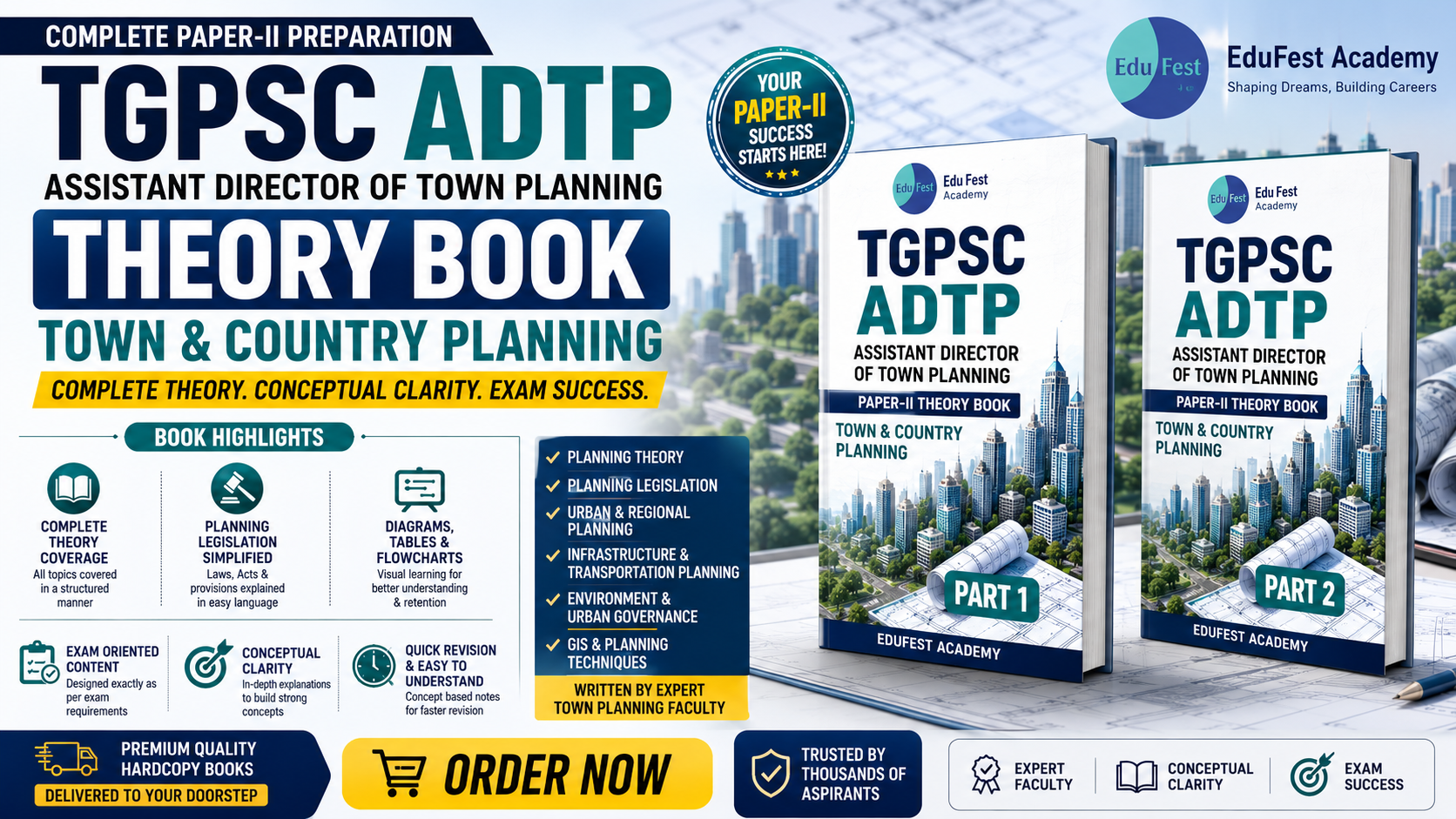 |
TGPSC ADTP Paper-II Theory Books (Vol. 1 & Vol. 2) | Hardcopy Notes | EduFest Academy The complete 2-volume printed theory set for Paper-II Town & Country Planning by Dr. Nikita Karwa - planning theory, legislation, techniques, GIS and smart cities, with exam-ready diagrams and tables across all 16 units. ₹1,400 |
📚 Free bare acts for TGPSC - read the exact laws you'll be tested on
Don't just read summaries. We've put the full text of the core TGPSC town-planning statutes online, free to read and download with no sign-up:
- Andhra Pradesh Town Planning Act, 1920
- Telangana Municipalities Act, 2019
- Greater Hyderabad Municipal Corporation (GHMC) Act
- RERA - Real Estate (Regulation & Development) Act
- Urban Development Authority Act
Open the TGPSC bare-acts library →
The 95% local reservation: why Telangana candidates have a real edge
Direct answer: this is a Multi-Zonal post with 95% local reservation, so most of the 10 seats are competed for among Telangana "local" candidates only.
- A candidate is "local" to a zone based on 4+ consecutive years of study (or residence) in that local area, per G.O.Ms.No.124.
- Multi-Zone I covers districts such as Adilabad, Karimnagar, Warangal, Khammam, Nizamabad, Mancherial, Peddapalli. Multi-Zone II covers Hyderabad, Rangareddy, Medchal-Malkajgiri, Nalgonda, Mahabubnagar, Sangareddy and neighbours.
- Applicants from other states are not entitled to any reservation and compete only for the small open quota.
Practical implication: if you studied your B.Arch/B.Plan/Civil or PG in Telangana (for example at JNAFAU, Hyderabad or another Telangana institution), confirm your local status early - it materially changes your odds against a 10-seat field.
Important dates & fees
Direct answer: apply between 10 July and 17 August 2026; the fee is Rs. 1,000 for OC/BC (Rs. 500 for SC/ST/PwD) plus a Rs. 120 exam fee that unemployed applicants do not pay.
- 10 Jul 2026Online applications open (tgpsc.gov.in)
- 17 Aug 2026, 5:00 PMLast date to apply
- ~7 days before examHall tickets released
- October 2026 (tentative)Written examination
Fees: Application processing Rs. 1,000 (OC/BC) / Rs. 500 (SC/ST/PwD); examination fee Rs. 120 - unemployed applicants are exempted, government employees pay it. A One Time Registration (OTR) on tgpsc.gov.in is required before you can apply.
How to prepare in ~10 weeks (a realistic plan)
Direct answer: with roughly 10 weeks to the October exam, front-load the high-weight Paper-II units and layer Telangana-specific GS on top.
Weeks 1-6
Build the syllabus base
Cover the 16 Paper-II units, prioritising legislation (Unit 12), planning techniques/URDPFI (Unit 2), housing/NBC 2016 (Unit 7) and current schemes (Unit 16).
Weeks 7-8
Lock the Telangana edge
Telangana-specific legislation & schemes (TS-bPASS, GHMC, HMDA, AMRUT/Smart Cities in Hyderabad & Warangal) - read them from the free TGPSC bare-acts library, not just notes.
Throughout
Daily General Studies
Daily GS for Paper-I - current affairs, Telangana geography/history/policies, and the Telangana Movement (bilingual English/Telugu).
Final 2 weeks
Mock tests & revision
Full-length objective mocks under time pressure; revise one-liners.
We publish a free unit-by-unit 8-week Paper-II study plan and a 1-page eligibility checklist for exactly this exam - see the TGPSC ADTP 2026 job page for the full notification and to get them.
Free downloads - no sign-up, straight to your device:
⬇ Eligibility checklist (PDF) ⬇ 8-week Paper-II study plan (PDF) 📚 TGPSC bare acts (free)
📚 TGPSC ADTP Paper-II Theory Books - 2-Volume Hardcopy Notes
The complete 2-volume printed theory set for Paper-II Town & Country Planning by Dr. Nikita Karwa - planning theory, legislation, techniques, GIS and smart cities, with exam-ready diagrams and tables across the full 16-unit syllabus.
₹1,400 ₹2,400 (42% OFF)
Order the Paper-II hardcopy notes → 🚚 Dispatch starts 15 July 2026 - order early to secure your copy.
Frequently Asked Questions (FAQ)
How many Assistant Director of Town Planning posts are there in TGPSC 2026?
10 posts - 5 in Multi-Zone I and 5 in Multi-Zone II of Telangana.
What is the last date to apply for TGPSC ADTP 2026?
17 August 2026, up to 5:00 PM, online at tgpsc.gov.in. Applications open on 10 July 2026.
Can a B.Tech Civil graduate apply for TGPSC Assistant Director of Town Planning?
Only if they also hold a PG degree or diploma in Town & Country Planning (or ITPI associateship). A Civil degree alone does not qualify.
Is the TGPSC ADTP exam in English or Telugu?
Paper-I (General Studies) is bilingual - English and Telugu. Paper-II (Town & Country Planning) is in English only.
What is the salary of an Assistant Director of Town Planning in Telangana?
The pay scale is Rs. 58,850 - Rs. 1,37,050.
Which cities are the TGPSC ADTP 2026 exam centres?
Hyderabad (including the HMDA area), Karimnagar, Khammam, Warangal and Nizamabad.
What are the qualifying marks for TGPSC ADTP 2026?
OC/EWS/Sportspersons 40%, BC 35%, SC/ST/PwD 30% - but final selection is by merit rank against the 10 vacancies.
Do candidates from outside Telangana get reservation?
No. It is a Multi-Zonal post with 95% local reservation; non-locals are not entitled to reservation and compete only for the open quota.
What topics are covered in TGPSC Assistant Director of Town Planning Paper-II?
Paper-II spans 16 units - planning theory (Garden City, Neighbourhood Unit, Concentric/Sector/Multiple-Nuclei theories), history of town planning (Indus Valley, Shilpa Shastra, Chandigarh), planning process and techniques (URDPFI, master and development plans, population forecasting), metropolitan and regional planning, infrastructure and services, traffic and transportation (BRTS, RRTS, TOD), housing, environment and disaster management (EIA, CRZ, NDMA), GIS/GPS/remote sensing, urban design and sustainability (SDGs, green buildings), project appraisal (PERT/CPM) and planning legislation including the Telangana Town Planning Act 1920 and Telangana Urban Areas (Development) Act 1975.
Sources & official links
- TGPSC official website: tgpsc.gov.in
- Notification No. 05/G/TP/2026 (dated 06/07/2026)
- Full job details & notification PDF: TGPSC ADTP 2026 job page
- Free bare acts for Paper-II legislation: TGPSC bare-acts library
- Coaching & free resources: TGPSC ADTP classes page
Disclaimer: figures are as per TGPSC Notification 05/G/TP/2026. Always verify against the official notification; the exam date is tentative until TGPSC confirms.