MPSC ATP: 148 recommended in revised list, next advertisement awaited
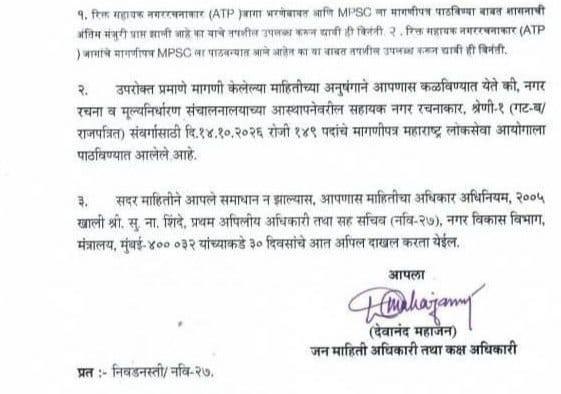
MPSC published the revised recommendation list (Advt. 051/2024, 8 Oct 2026). Requisition for 149 vacancies sent to the MPSC on 14 Oct 2026. Notification date and exam date are unannounced. Use this window to build your base.
Official RTI Reply
MPSC Assistant Town Planner (Group-B): Requisition for 149 Vacancies Sent to MPSC on 14 October 2026
Quick answer: A draft becomes a Bill when it is tabled, and an Act when both Houses pass it and assent is given. An Ordinance is urgent law made in recess. Rules say how to implement an Act, Regulations come from statutory bodies, and a Code bundles them all.
Watch the free lecture on YouTube (Marathi)
· More free MPSC ATP lectures
The ATP syllabus names the MLRC Code, the MR&TP Act and the Land Acquisition, Rehabilitation and Resettlement Act together. Knowing what each word means tells you which document you are reading and which one prevails.
First, who makes, implements and interprets law
| Organ | Role | Centre | State |
|---|---|---|---|
| Legislature | Makes law | President, Lok Sabha, Rajya Sabha | Governor, Vidhan Sabha, Vidhan Parishad |
| Executive | Implements law | President, Vice-President, PM and Cabinet | Governor, CM, Council of Ministers |
| Judiciary | Interprets law | Supreme Court, High Courts, subordinate courts | High Court, subordinate courts |
The Land Acquisition, Rehabilitation and Resettlement Act, 2013 is a Central Act. The MR&TP Act, 1966 is a State Act.
Draft, Bill, Act: the journey of a law
The same text changes its name at each stage. Learn the trigger for each name and the question writes itself.
Draft
The proposal before it is submitted to the legislature. A department, committee or expert body prepares it.
Bill
The same text once it is tabled in the House. It is discussed and voted on in the Lok Sabha and Rajya Sabha (Vidhan Sabha and Vidhan Parishad in a State).
Act
The Bill after both Houses pass it and the President (Centre) or Governor (State) gives assent. Now it is law.
Centre
Draft → Bill in Parliament (Lok Sabha and Rajya Sabha) → President's assent → Act
State
Draft → Bill in Vidhan Sabha and Vidhan Parishad → Governor's assent → Act
Ordinance: law made in recess
Parliament does not sit all year. The usual pattern is the Budget, Monsoon and Winter sessions, but nothing fixes the months. The one fixed rule: two sessions can never be more than six months apart. The gap between two sessions is the recess.
Suppose something urgent needs a law during the recess. A Bill cannot be passed because the House is not sitting, so the Constitution lets the Executive issue a stop-gap law called an Ordinance.
President
Issues Ordinances while Parliament is not in session.
Governor
Issues Ordinances while the State Legislature is not in session.
The Ordinance clock
- Placed before the legislature as soon as it reassembles.
- Lapses six weeks after reassembly unless an Act replaces it. It ends earlier if the House passes a resolution disapproving it.
- The logic: the next session is at most six months away, so an Ordinance cannot run unchecked for long. Once the House meets, it has six weeks to discuss it and either pass it as an Act (with amendments if needed) or let it lapse.
- Same force as an Act while it operates, but only temporary.
In the MR&TP Act, 1966, the time limits in Sections 30 and 31 needed to change. The legislature was not sitting and the matter was urgent, so an Ordinance was issued. Check the Ordinance and the amending Act for the exact text before quoting it.
Writing the validity as "6 months 6 weeks".
Rules, Regulations, Code
| Term | What it is | Example |
|---|---|---|
| Rules | Detail on how to implement an Act on the ground | The Act says appoint an Arbitrator; the Rules say who, pay and powers |
| Regulations | Made by a statutory body to govern how it operates | RBI, SEBI, AICTE |
| Code | Act plus Rules, Schedules and related provisions in one document | Maharashtra Land Revenue Code (boundaries, disposal of government land) |
Hierarchy: why the Act beats the GR
The order of authority is Central Act, then State Act, then Rules, then GR. If a GR says something different from the Act, the Act prevails. The lecture's example: Section 38 of the MR&TP Act requires the Development Plan to be revised within 20 years, while a GR says to begin preparing the next plan three years before the 20 years end. The GR can guide the process, but it cannot override Section 38.
10 practice MCQs: tap an option to check
1A proposal that has not yet been submitted to the legislature is called a:
- ABill
- BDraft
- CAct
- DOrdinance
Tap an option to check your answer.
Before submission it is a draft. Once tabled for discussion and voting it is a Bill.
2Once a proposed law is submitted to Parliament for discussion and voting, it is called a:
- ADraft
- BRule
- CBill
- DCode
Tap an option to check your answer.
Submission to the legislature turns the draft into a Bill.
3A Bill becomes an Act after:
- APassing only the Lower House
- BBeing issued as an Ordinance
- CBeing drafted by the Executive
- DPassing both Houses and receiving assent
Tap an option to check your answer.
Both Houses pass it, then the President (Centre) or Governor (State) gives assent.
4An Ordinance is issued when:
- AThe legislature is not in session and there is an urgency
- BParliament is in session
- CA Bill is rejected
- DA court orders it
Tap an option to check your answer.
It is a stop-gap law for the recess period.
5The President's power to issue an Ordinance and the Governor's power are in Articles:
- A72 and 161
- B123 and 213
- C110 and 199
- D356 and 352
Tap an option to check your answer.
Article 123 (President) and Article 213 (Governor).
6An Ordinance must be placed before the legislature, and it lapses:
- ASix days after it is issued
- BAfter one year
- CSix weeks after the legislature reassembles
- DOnly when the court strikes it down
Tap an option to check your answer.
It ceases six weeks after reassembly (earlier if the House disapproves). The gap between two sessions is at most six months.
7Rules under an Act mainly explain:
- AWho may vote on the Bill
- BHow the court interprets the Act
- CHow a Bill is drafted
- DHow the Act is to be implemented on the ground
Tap an option to check your answer.
Acts cannot carry every detail, so Rules give the implementation detail, for example Arbitrator rules under TP schemes.
8Regulations are typically made by:
- AStatutory bodies such as RBI, SEBI and AICTE
- BThe Supreme Court
- CGram Sabhas
- DThe Lok Sabha Speaker
Tap an option to check your answer.
Statutory bodies frame regulations to govern how they operate.
9A Code, such as the Maharashtra Land Revenue Code, is:
- AOnly a Bill
- BA combination of the Act, Rules, Schedules and related provisions
- COnly an Ordinance
- DA court judgment
Tap an option to check your answer.
A Code bundles the Act with its Rules and Schedules in one document.
10If an Act and a GR conflict, which prevails?
- AThe GR
- BWhichever is newer
- CThe Act
- DThe one issued by the Collector
Tap an option to check your answer.
Order of authority: Central Act, State Act, Rules, then GR.
Now solve the free PYQ papers to see how these points are asked in real exams.
Learn the MR&TP Act live with MPSC ATP 2027
Every topic in the batch ends with MCQs, a workbook PDF, hardcopy notes and flashcards. Fee Rs 14,000, payable in two instalments of Rs 7,000. See the study-order guide or more free demo lectures.
Join the running MPSC ATP 2027 batch (late entry open) →
FAQs
What is the difference between a draft and a Bill?
A draft is a proposal before submission. When it is submitted to the legislature for discussion and voting, it is called a Bill.
Why is an Ordinance issued?
When the legislature is in recess and a law is urgently needed. The President issues it under Article 123 and the Governor under Article 213.
How long does an Ordinance last?
It must be placed before the legislature and lapses six weeks after the legislature reassembles. Two sessions are never more than six months apart.
What is the difference between Rules and Regulations?
Rules explain how an Act is implemented. Regulations are framed by statutory bodies such as RBI, SEBI and AICTE to govern their own working.
What is a Code?
A Code combines the Act, Rules, Schedules and related provisions in one document, for example the Maharashtra Land Revenue Code.