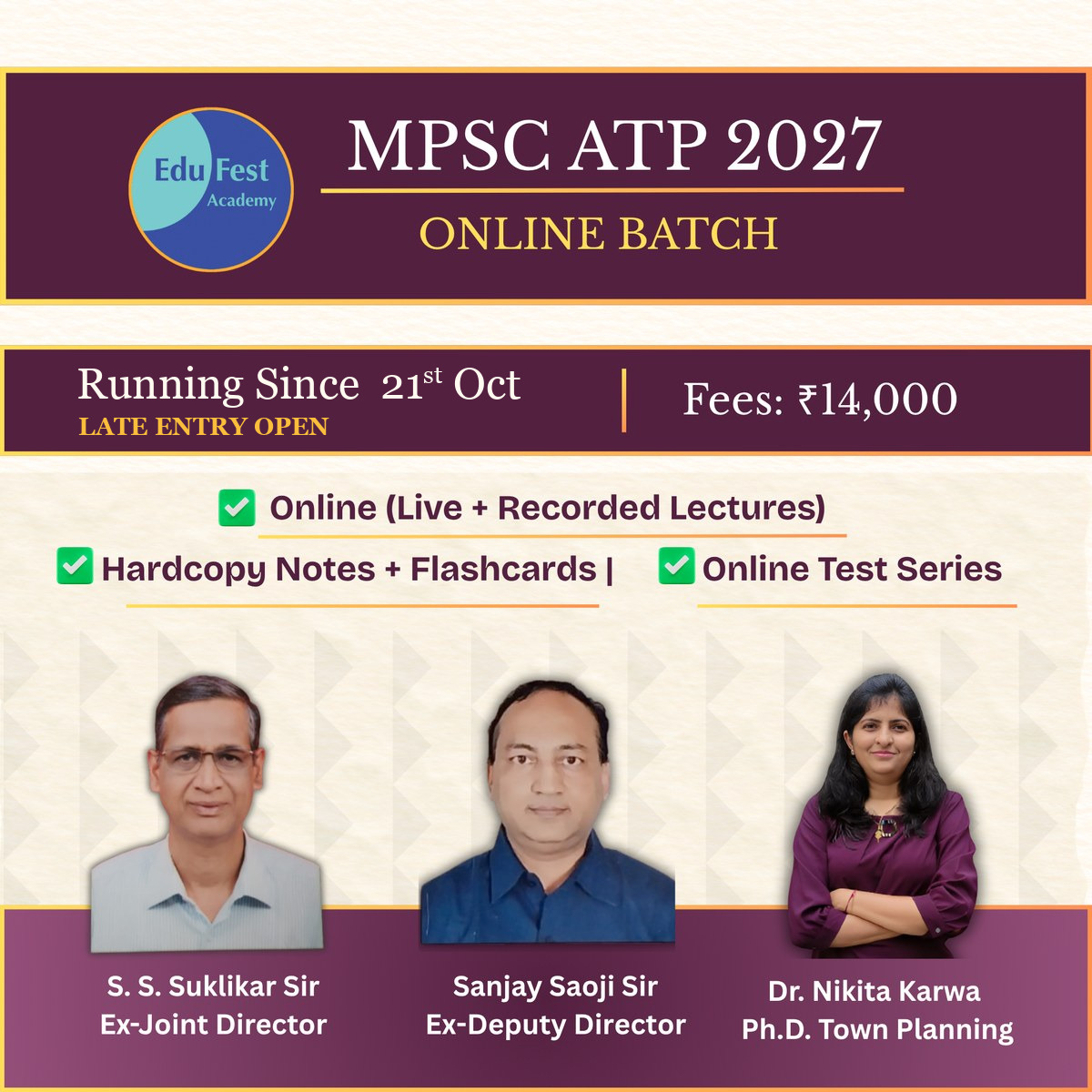
MPSC ATP: 148 recommended in revised list, next advertisement awaited
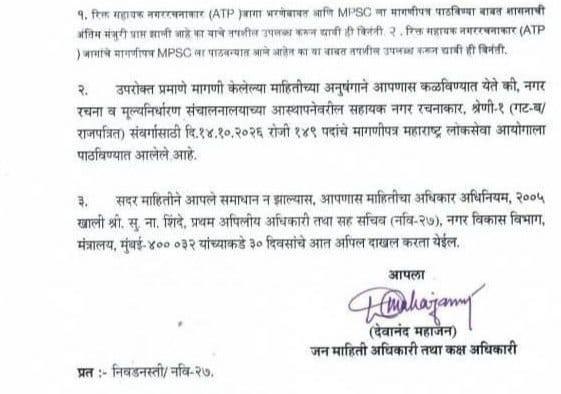
MPSC published the revised recommendation list (Advt. 051/2024, 8 Oct 2026). Requisition for 149 vacancies sent to the MPSC on 14 Oct 2026. Notification date and exam date are unannounced. Use this window to build your base.
Official RTI Reply
MPSC Assistant Town Planner (Group-B): Requisition for 149 Vacancies Sent to MPSC on 14 October 2026
Quick answer: Cost is what it takes to build, price is cost plus profit, and value is what the property is worth to a buyer on a given date. Value rests on utility, scarcity, desirability, purchasing power, supply and demand, and marketability, and is affected by economic, physical, social and legal factors. The key types are market, realizable, forced sale, investment and scrap value.

Watch the free Valuation lecture on YouTube
· More free MPSC ATP lectures
Valuation, with the MR&TP Act and UDCPR, is one of the three most important topics of the syllabus. As explained in the lecture, it can bring 12 to 15 questions (about 30 marks): general valuation, methods, tables, land acquisition and SR. These notes cover the basics and end with 25 practice MCQs. For the study order, see the preparation strategy guide.
Tangible and intangible property
- Tangible: can be touched (land, building, laptop, gold).
- Intangible: cannot be touched but has value (knowledge, copyright, patent).
- Tangible property is real (immovable: land, building) or movable (gold, cash, laptop). Movable property needs no registration or stamp duty to pass on.
- For the ATP syllabus the focus is land and building.
- Career note from the lecture: chartered valuers qualify through IBBI, in land and building, plant and machinery, or securities and insolvency.
Cost vs price vs value
| Term | Meaning | Example |
|---|---|---|
| Cost | Exact amount spent to build or produce, found by estimation and costing | Excavation, bar bending, RCC, beams added up |
| Price | Cost plus profit; what the seller asks | MRP of a Maggi packet |
| Value | Worth to a particular buyer; depends on benefit, location, date, sentiment | A grandfather's house kept for memories |
The usual order is cost < price < value, but real life does not always follow it. Value is a bundle of rights that comes with the property, and date and time are the most important parts of a valuation (property rates fell sharply in the 2020 lockdown).
Elements of value
- Utility: satisfaction or benefit to the consumer, direct or indirect (saving time).
- Scarcity: limited supply raises value. This is why metro land goes vertical.
- Desirability: how many people want it.
- Effective purchasing power: buyers must be able to pay.
- Supply and demand: more sellers lower value, more buyers raise it.
- Marketability: transferability. A copyright or one's knowledge has value but cannot be transferred.
Factors affecting value
| Factor | Examples |
|---|---|
| Economic | Recession, GDP, income and wages, employment opportunities |
| Physical | RCC frame or load-bearing, age, condition (like a used car's model and running) |
| Social | Locality and status, neighbourhood (a nala nearby), density, personal and religious beliefs |
| Legal | Building bye-laws, zoning, restrictions (biodiversity park), FSI increase near a metro, land acquisition |
Types of value (first definitions)
| Type | Key idea |
|---|---|
| Market value | Estimated amount exchanged on the valuation date between a willing buyer and willing seller in an arm's-length transaction (no relationship, no force) |
| Realizable value | Market value minus taxes, holding cost and selling cost (as explained in the lecture) |
| Forced sale value | Seller must sell compulsorily without proper marketing; where-is, as-is basis; usually lower than market value |
| Investment value | Value to an investor for future economic benefit, not own use; includes a speculative element |
| Scrap (junk) value | Value of materials at the end of useful life |
More definitions (25 for value and 25 for rent) are covered in the next lectures of the batch.
25 practice MCQs: tap an option to check
1Valuation is best defined as the process of determining the:
- AOriginal construction cost only
- BPresent worth of an asset on a given date
- CFuture rent of an asset only
- DRegistration charges of an asset
Tap an option to check your answer.
Valuation estimates what an asset is worth today, so the valuation date matters.
2Which of the following is a tangible asset?
- ACopyright
- BPatent
- CA building
- DA person's knowledge
Tap an option to check your answer.
Tangible assets can be touched. Copyright, patents and knowledge are intangible.
3Which of the following is an intangible asset?
- ALand
- BLaptop
- CGold
- DCopyright
Tap an option to check your answer.
A copyright has value but cannot be touched.
4Land and building are classified as:
- AReal (immovable) property
- BMovable property
- CIntangible property
- DPersonal property
Tap an option to check your answer.
Land and buildings cannot be moved, so they are real property.
5The exact amount spent in constructing a building, found through detailed estimation, is its:
- APrice
- BCost
- CValue
- DRent
Tap an option to check your answer.
Cost is the exact expenditure; estimation and costing deal with it.
6Price of a property is generally:
- ACost minus depreciation only
- BValue minus profit
- CCost plus profit
- DScrap value plus tax
Tap an option to check your answer.
A seller adds a profit margin to cost to arrive at the price.
7The worth of a property to a particular buyer, including sentiment and benefit, is its:
- ACost
- BPrice
- CEstimate
- DValue
Tap an option to check your answer.
Value is subjective and depends on the buyer's benefit.
8In the usual sequence, which is generally lowest?
- ACost
- BPrice
- CValue
- DAll are always equal
Tap an option to check your answer.
The usual order is cost, then price, then value, though real life can differ.
9Value is described as a:
- AFixed number set by the government
- BBundle of rights that comes with the property
- CTotal of taxes paid
- DSum of loans on the property
Tap an option to check your answer.
Ownership gives the right to use the land, and that bundle of rights is what is valued.
10Which factor is most critical when preparing a valuation report?
- AColour of the building
- BName of the owner
- CDate of valuation
- DNumber of floors only
Tap an option to check your answer.
Values change with time, so the valuation date must be stated.
11Utility in valuation refers to:
- ANumber of rooms in the building
- BAge of the building
- CGovernment subsidy
- DSatisfaction or benefit the consumer derives from the property
Tap an option to check your answer.
Utility is the satisfaction or benefit to the consumer.
12If the supply of flats increases while demand stays the same, the value of the property:
- ADecreases
- BIncreases
- CRemains the same
- DBecomes zero
Tap an option to check your answer.
More sellers mean lower value.
13If demand for property in a city increases (more buyers), the value:
- ADecreases
- BIncreases
- CRemains the same
- DCannot be known
Tap an option to check your answer.
More buyers push value up.
14Scarcity of land in metro cities pushes people to build:
- AHorizontally
- BUnderwater
- CVertically
- DOnly on hills
Tap an option to check your answer.
Limited land supply makes vertical growth necessary and raises prices.
15A copyright is not marketable mainly because it:
- AHas no value to the owner
- BIs illegal to own
- CIs always free
- DCannot be transferred to another person like a commodity
Tap an option to check your answer.
Marketability means transferability; the owner's own knowledge cannot be handed over.
16A new metro station raises FSI around it and so increases property value. This is a:
- ALegal factor
- BPhysical factor
- CSocial factor
- DPersonal factor
Tap an option to check your answer.
FSI and regulations are legal factors.
17Type of structure (RCC frame or load-bearing) and age of the building are:
- AEconomic factors
- BPhysical factors
- CSocial factors
- DLegal factors
Tap an option to check your answer.
The condition of the property itself falls under physical factors.
18Locality status, neighbourhood and density are:
- AEconomic factors
- BPhysical factors
- CSocial factors
- DLegal factors
Tap an option to check your answer.
People, status and neighbourhood are social factors.
19The estimated amount for which an asset would exchange on the valuation date between a willing buyer and a willing seller in an arm's-length transaction is:
- AForced sale value
- BScrap value
- CInvestment value
- DMarket value
Tap an option to check your answer.
This is the standard definition of market value.
20A sale to a close friend at a concessional price is not an arm's-length transaction because:
- AA relationship exists between buyer and seller
- BThe price is too high
- CThe property is movable
- DThe date is unknown
Tap an option to check your answer.
Arm's length means the parties have no relationship or pressure.
21The value obtained when a seller is compelled to sell without proper marketing exposure is:
- AMarket value
- BForced sale value
- CInvestment value
- DRealizable value
Tap an option to check your answer.
A forced sale is on a 'where is, as is' basis and usually fetches less.
22The value of land bought in the outskirts only for future economic benefit, not for own use, is:
- AScrap value
- BForced sale value
- CInvestment value
- DMarket value
Tap an option to check your answer.
Investment value is specific to an investor's expectation of future benefit.
23The value of a building at the end of its useful life, based on salvage materials, is:
- AMarket value
- BInvestment value
- CForced sale value
- DScrap (junk) value
Tap an option to check your answer.
Scrap value is what the materials fetch when useful life ends.
24As explained in the lecture, realizable value is market value:
- AMinus taxes, holding cost and selling cost
- BPlus profit
- CPlus stamp duty
- DWithout any change
Tap an option to check your answer.
Realizable value is what remains after such deductions.
25Which expenditure is the basis of 'estimation and costing'?
- AMarket rent
- BCost of construction
- CScrap value
- DForced sale value
Tap an option to check your answer.
Estimation and costing deals with the cost of construction.
Now solve the free PYQ papers to see how these points are asked in real exams.
Learn Valuation live with MPSC ATP 2027
Every topic in the batch ends with MCQs, a workbook PDF, hardcopy notes and flashcards. Fee Rs 14,000, payable in two instalments of Rs 7,000. See more free demo lectures.
See the MPSC ATP 2027 Online Batch →
FAQs
How many questions come from Valuation in the MPSC ATP exam?
As explained in the lecture, Valuation can bring about 12 to 15 questions (around 30 marks), covering general valuation, methods, tables, land acquisition and SR.
What is the difference between cost, price and value?
Cost is the exact amount spent to build or produce. Price is cost plus profit. Value is the worth to a particular buyer and depends on benefit, location, date and sentiment.
What is market value?
The estimated amount for which an asset would exchange on the valuation date between a willing buyer and a willing seller in an arm's-length transaction.
What is forced sale value?
The value when the seller must sell compulsorily, without proper marketing exposure, on a where-is, as-is basis. It is usually lower than market value.
What are the four groups of factors affecting value?
Economic, physical, social and legal factors.
Which elements create value?
Utility, scarcity, desirability, effective purchasing power, supply and demand, and marketability.