MPSC · MAHARASHTRA · ASSISTANT TOWN PLANNER · SELF-STUDY
Quick answer: The MPSC ATP 2027 Hardcopy Notes are a two-book printed set (Part 1 + Part 2, ₹1,200) written by Dr. Nikita Karwa with ex-Joint and ex-Deputy Directors of the Maharashtra Town Planning Department. They put the exam's core theory, law and valuation topics in one place, which is exactly what a self-study aspirant is missing.
| 2Printed books |
₹1,200Complete set |
3Expert authors |
IndiaHome delivery |
The real problem with self-study for MPSC Assistant Town Planner
Direct answer: self-study aspirants rarely fail from lack of effort. They lose time collecting material. MPSC ATP covers planning theories, the MR&TP Act, UDCPR, valuation, transportation, land revenue and government schemes. Without a guide, you gather Act PDFs, random slides and old notes, and never know which parts the exam actually tests.
- Material is scattered across Acts, rules, gazettes and websites.
- Nobody tells you which sections and which topics matter for MCQs.
- Revision has no fixed structure, so topics are forgotten before the exam.
- Town Planning Department terms are hard to follow with no teacher to explain them.
What is inside: Part 1 and Part 2 (complete index)
Direct answer: Part 1 has 16 chapters (planning theory, legislation, transport, land revenue, valuation, disaster management and more) and Part 2 has 7 chapters (UDCPR, government schemes, remote sensing, GPS, GIS, RTI/RTS and the Environment Protection Act). Tap a chapter to see every topic listed in the books' index pages.
| Book |
Chapter and topics |
Part 1
Ch. 1 |
Planning Theory16 topics inside
- Meaning of Planning Theory
- Importance of Planning Theory
- Two Streams of Planning Theory
- Stream 1: Objective-Based Approach
- Sir Patrick Geddes
- C.A.Perry - Neighbourhood Concept
- Radburn, New Jersey
- Lewis Mumford
- Central Place Theory
- Losch's Central Place Theory
- Primate City- Rank Size Rule
- What are urban settlement?
- Stream 2: Method-Based Approach
- Concentric Zone Model
- Sectors Model
- Multiple Nuclei Model
|
Part 1
Ch. 2 |
Evolution of Town Planning in India8 topics inside
- Overview
- 1898-1915: Improvement Trusts
- 1915-1930: First Town Planning Acts and Geddes
- Patrick Geddes (in India 1915-20)
- Central Government Initiatives (Five Year Plans)
- Modern Town Planning in India
- Emerging concepts of cities
- Planning Process
|
Part 1
Ch. 3 |
History of Town Planning Legislation, MR&TP Act 1966 and Land Acquisition (LARR)18 topics inside
- The Bombay Town Planning Act 1915
- The Bombay Town Planning Act 1954
- Maharashtra Regional and Town planning Act 1966
- New Towns (Section 113 to 124)
- Maharashtra Regional and Town Planning (Regional Planning Board) Rules, 1967
- Maharashtra Development Plans Rules, 1970
- Maharashtra Regional Planning Boards (Finance and Accounts) Rules, 1967
- LA Act 1894
- Right to Fair Compensation and Transparency in Land Acquisition, Rehabilitation and Resettlement Act (LARR) 2013
- Rehabilitation and resettlement award
- Provision of infrastructural amenities in resettlement area
- Power to take possession of land to be acquired
- Special powers in case of urgency to acquire land in certain cases
- Special provisions for Scheduled Castes and Scheduled Tribes
- Definition of affected family
- Difference between LA Act 1894 and LARR Act 2013
- Pre Notification Stage
- Post Notification Stage
|
Part 1
Ch. 4 |
Transportation Planning22 topics inside
- Types of Urban or Road Systems
- Urban Roads
- Other Roads
- Transportation Survey
- Idefinition of Study Area
- Zoning
- Types of Survey
- Classification of Grade Separated Intersection
- Sign and Their Importance
- Transit Orientated Development
- Designed as walkable areas Traffic and Transportation
- Level of Service
- Collision Diagram
- Segregation by grade separator
- Freight Transportation
- Future Development
- Bus Rapid Transit System (BRTS)
- Mass Rapid Transit System (MRTS)
- Intelligent Transport Systems (ITS)
- Public–Private Partnerships
- Transport System
- Mode Choice Modelling
|
Part 1
Ch. 5 |
Maharashtra Land Revenue Code 196611 topics inside
- Land Record
- Department of Land Records
- Functions of the Land Records department are as follows
- List of Land Records
- Occupant and occupancy
- Local name of field
- Potkarab
- Village Form XII
- Maharashtra Land Revenue (Inspection, Search and Supply of Copies of Land Records) Rules
- Some Basic Definition related to agricultural Land
- Activities permitted for the better cultivation of the land
|
Part 1
Ch. 6 |
Valuation15 topics inside
- Valuation
- Purpose of Valuation
- Important Terms
- Basic Elements of Value - Marketability, Utility, Scarcity, And
- Highest and Best Use, Value In Use, Value Inexchange
- Basics of Microeconomics
- Landed Properties and Demand Supply Relation
- Subjectivity in Valuation
- Evaluating Utility.
- Present Value: Discounted Cash Flow [D.C.F.]
- Interest in landed property
- Type of Interest in Landed Properties
- Forms of Value
- Important Terms In Valuation
- Different Types of rent
|
Part 1
Ch. 7 |
Methods of Valuation6 topics inside
- Factors for Valuation of Land
- Methods of Valuation
- Valuation Tables
- Depreciation
- Functional obsolescence
- Methods of Depreciation
|
Part 1
Ch. 8 |
Annual Statement of Rates (ASR)2 topics inside
- Annual statement of rates of immoveable property
- Stamp Duty
|
Part 1
Ch. 9 |
Local Area Plan3 topics inside
- Local Area Plan (URDPFI Guidelines)
- Contents of Local Area Plan
- Contents of Zonal Development Plan
|
Part 1
Ch. 10 |
Municipal Acts (in light of 73rd and 74th Constitutional Amendment)2 topics inside
- The 73rd Constitutional (Amendment) Act, 1992
- Key Points
|
Part 1
Ch. 11 |
Disaster Management11 topics inside
- What is Disaster?
- Vulnerability
- Disaster Management in India
- National disaster management Act 2005
- National Disaster Management Authority
- National Disaster Management Plan, 2016
- National Institute of Disaster Management
- National Disaster Response Force
- National Disaster Response Fund
- Resilient cities
- Incident Response System
|
Part 1
Ch. 12 |
Important Current Affairs related to Planning11 topics inside
- Regional Rapid Transit System
- ‘Experience Studio on Drones’
- India’s first EV charging station
- Swachh Survekshan 2023
- Atal Innovation Mission (AIM)
- Pradhan Mantri Mudra Yojana
- Underwater river tunnel
- SVANidhi se Samriddhi
- Rashtriya Gram Swaraj Abhiyan (RGSA)
- Gagan
- Planners and their Contributions
|
Part 1
Ch. 13 |
Authorities of Maharashtra7 topics inside
- Cidco
- Navi Mumbai Airport Influence Notified Area (NAINA)
- MSRDC - Maharashtra State Road Development Corporation Limited
- DP Along Mumbai Pune Express Way
- Krishi Samruddhi Mahamarg (New Town)
- Development Authorities, and Area Development Authority under MRTP Act,1966
- Population Forecasting Methods
|
Part 1
Ch. 14 |
Special Area Plan3 topics inside
- Eco-sensitive areas
- Zonal Plans, Sector Plans
- Slum
|
Part 1
Ch. 15 |
Maharashtra Municipal Corporations Act, 19493 topics inside
- Chapter-wise Index
- Chapter Xv. Building Regulations.
- Chapter Xvi. Improvement Schemes.
|
Part 1
Ch. 16 |
Maharashtra Municipal Councils, Nagar Panchayats and Industrial Townships Act, 19652 topics inside
- Chapter Ix – Municipal Taxation
- Chapter Xii – Control Over Buildings.
|
Part 2
Ch. 1 |
UDCPR (Unified Development Control and Promotion Regulations)24 topics inside
- Building bye laws essentially aims:
- What to achieve by BB and DCPR
- Set of regulations categorized into 15 chapters
- Chapter – 1 Administration
- Chapter – 2 Development Permission and Commencement Certificate
- Chapter 5: Additional Provisions for Regional Plan Areas
- General Building Requirements – Setback, Marginal Distance, Height and
- Chapter 7: Higher FSI for Certain Uses
- Chapter 8: Parking Spaces
- Chapter: 10 Accomodation Reservation and Transferable
- Chapter 13: Special Provisions For Certain Buildings
- Chapter 14: Special Provisions /Schemes / Policies
- Integrated Township POlicy
- Chapter – 15 Regulations For Special Activities / Plans
- Approval of Building permission on Risk Based Classification
- Premium Charges –
- Discretionary Powers – Relaxations in Specific Cases
- Drafting Error
- Removal of Difficulties
- Redevelopment of Old Dilapidated/ Dangerous Buildings
- Development of Housing For Ews/ Lig
- Affordable Housing Scheme
- Incentive For Green Buildings
- Conservation of Heritage Buildings
|
Part 2
Ch. 2 |
Urbanisation, Government Schemes and Missions48 topics inside
- Atal Mission for Rejuvenation and Urban Transformation (AMRUT)
- Shyama Prasad Mukherji Rurban Mission
- Maharashtra Samruddhi Corridor
- PMAY - Pradhan Mantri Awas Yojna (PMAY)
- Pmay 2.0
- Pradhan Mantri Awas Yojana - Urban 2.0 (PMAY-U 2.0) Guidelines
- Coverage
- Eligibility Criteria
- Income Categories
- Preference to Vulnerable Groups
- Parent Beneficiary Clause
- Excluded Sanctioned Houses
- Avoiding Duplication
- Aadhaar Requirement
- Implementation Methodology
- PMAY-U 2.0 Verticals
- Beneficiary Led Construction (BLC)
- Interest Subsidy Scheme (ISS)
- Role of Central Nodal Agencies (CNAs)
- Implementation & Monitoring by CNAs
- Technology & Innovation Sub-Mission (TISM)
- Special Innovative Projects under PMAY-U 2.0
- Convergence with Other Schemes
- Funding Pattern
- Mechanism for Release of Central Assistance
- Tracking & Monitoring
- Mechanism for Release of Central Assistance under Interest Subsidy Scheme
- Capacity Building Activities
- Establishment of Technical Cells
- Administration and Implementation Structure
- Unified Web Portal & Management Information System (MIS)
- Affordable Housing Policy
- Reforms to be Implemented
- Central Government Support
- Additional Support (in consultation with Ministry of Finance)
- Monitoring & Evaluation
- Mid-Term Evaluation
- Smart City
- Strategy
- Pan City Development (To cover larger part of the city)
- How many Smart Cities in each State?
- Implementation of Smart Mission
- Financing of Smart Cities
- Coverage and Duration
- Heritage City Development and Augmentation Yojana (HRIDAY)
- State Housing Policy (Draft)
- Maharashtra State Housing Policy, 2024 – Summary
- Summary of Maharashtra State Housing Policy, 2024
|
Part 2
Ch. 3 |
Fundamentals of Remote Sensing and its Applications in Urban Planning16 topics inside
- What is Remote Sensing?
- Why Remote Sensing?
- History of Remote Sensing
- Milestones in the History of Remote Sensing
- Remote Sensing Process
- Components of Remote Sensing
- Types of Remote Sensing
- Remote Sensing Data Collection
- New Emerging Remote Sensing Data Collection Technology
- Spectral Reflectance and Earth Surface Interaction
- Characteristics of Images
- Satellites and Sensors
- Specification of Indian Earth Observation Satellites
- Types of Resolution
- Image Analysis and Interpretation
- Remote Sensing Applications in Urban Planning
|
Part 2
Ch. 4 |
Global Positioning System and Applications9 topics inside
- Overview
- Introduction and Overview of GPS
- Characteristics of GPS
- GPS Segments
- What are satellite constellations?
- Types of GPS
- Applications of GPS
- Municipals
- Drone / UAV
|
Part 2
Ch. 5 |
Introduction to Geographic Information System (GIS)26 topics inside
- History of GIS
- Geospatial Technology
- What is GIS?
- GIS Data Model
- Components of GIS
- GIS Data Models / Types
- Functions of GIS
- Creation of GIS Data / Database
- Analysis Methods: I. Logical Overlay
- Analysis Methods: II. Geoprocessing
- Applications of GIS
- Government Resolutions and Design Standards
- Background
- Preparation of Development Plan (DP) as per MR & TP Act, 1966
- DGPS
- Georeferencing of High-Resolution Images
- Total Station Survey
- Analysis Example: Preparation of Development Plan & Urban Planning
- Introduction to Total Station and its Applications
- Introduction
- Surveying Methods
- Traditional Surveying Methods
- Advanced Surveying Methods
- Types of Total Station
- How Total Station Works
- Applications of Total Station
|
Part 2
Ch. 6 |
Right to Information (RTI) Act and Right to Service (RTS) Act11 topics inside
- Historical Background of RTI Act, 2005
- Key Points
- Objectives of the Act
- Points to be noted u/s 8
- Section 11 Third Party Information
- Section 12 Central Information Commission
- Section 15 State Information Commission
- Section 19: Appellate Authorities under the Act
- Section 18: Complaint to Information Commissions (IC)
- Points to be noted
- The Maharashtra State Commission for Right to Service
|
Part 2
Ch. 7 |
Environment Protection Act, 198665 topics inside
- Environmental Impact Assessment (EIA) - Overview
- Key Values of EIA
- Types of EIA
- Evolution of EIA
- Types of EIA in India
- Environmental Management Plan (EMP)
- Key Objectives of EIA
- Importance of Public Participation in EIA
- Differences Between EIA Notification 2006 and Draft 2020
- Types of Impacts Considered in EIA
- Legal and Institutional Framework in India
- Stakeholders in EIA
- Environmental Clearance Process in India
- Challenges in EIA
- Decentralization of Environmental Clearance
- Importance of Environmental Impact Assessment (EIA)
- Principles and Features of EIA
- Examples of EIA Applications
- Legal Framework for EIA in India
- Advantages of EIA
- Polluter Pays Principle (PPP)
- Implementation of PPP: International Examples
- Polluter Pays Principle in India
- Examples of PPP Enforcement in India
- Key Entities Enforcing PPP in India
- Eco-Sensitive Zones (ESZs)
- Notable Eco-Sensitive Zones in India
- Noise Pollution Standards in India
- Greenhouse Effect and Global Warming
- Coastal Regulation Zones (CRZs)
- E-Waste Management
- Environmental Protection under the Indian Constitution
- Key Case Laws in Environmental Protection
- Role of the Ministry of Environment, Forest and Climate Change (MoEFCC)
- National Green Tribunal (NGT)
- Sustainable Development Goals (SDGs) and Environmental Protection
- Waste Management and Recycling in India
- Environmental Laws in India – Key Amendments and Acts
- The Water (Prevention and Control of Pollution) Act, 1974
- The Air (Prevention and Control of Pollution) Act, 1981
- The Forest (Conservation) Act, 1980
- National Action Plan on Climate Change (NAPCC)
- The Role of Technology in Environmental Protection
- Wastewater Treatment and Water Conservation
- Climate Change Adaptation and Mitigation in India
- Air Pollution and Its Control
- Waste Management and Recycling
- Water Pollution and Its Control
- Climate Change and Its Impact on India
- Renewable Energy and Sustainability
- International Environmental Cooperation
- Sustainable Development Goals (SDGs)
- Climate Change and Global Warming
- Renewable Energy Sources
- Biodiversity and Conservation
- Waste Management
- International Environmental Agreements
- EIA Notification 2006
- EIA cycle and procedures
- Noise standards (as notified in Environment (Protection) Rules, 1986)
- Greenhouse Effect
- Eco Sensitive Zone
- Polluter Pay Principal
- Costal Regulation Zone
- Types of Surveys
|
These cover the core of the probable 2027 syllabus. See the full 19-topic list in our MPSC ATP FAQ and syllabus guide.
Why these notes suit self-study students
Direct answer: they replace the hunt for material with one exam-oriented source, written by the people who run the department.
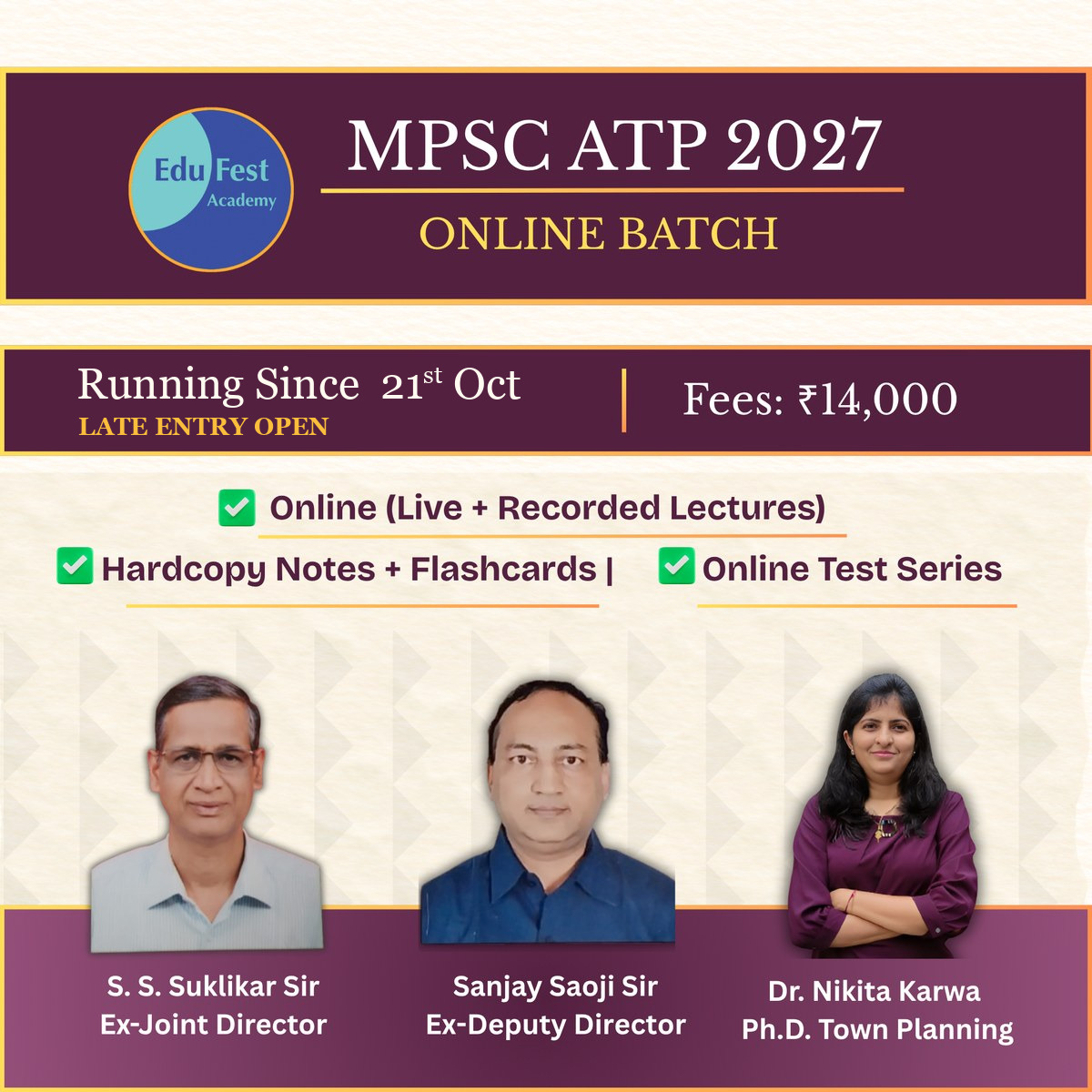
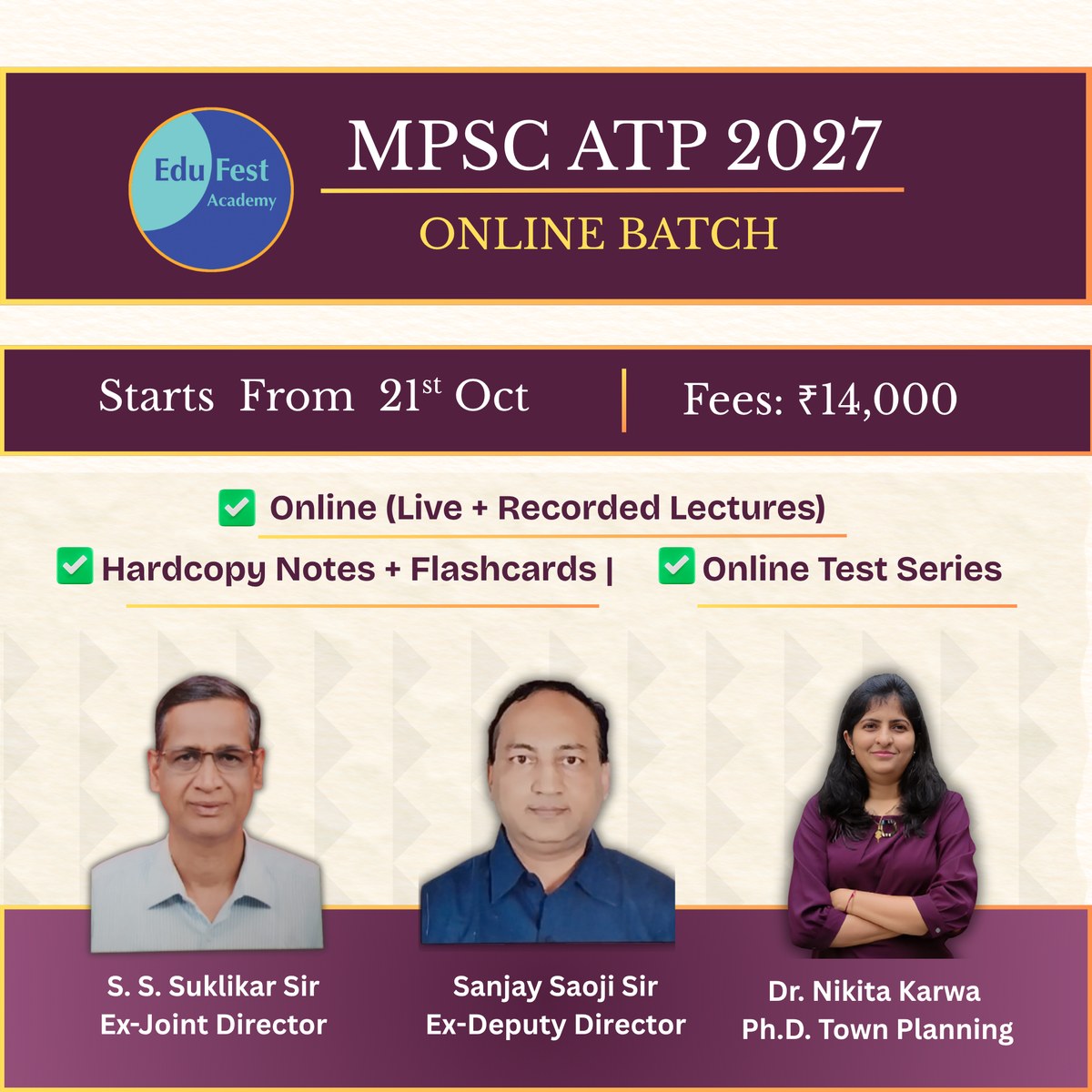
- Written by insiders. S. S. Suklikar Sir (Ex-Joint Director) and Sanjay Saoji Sir (Ex-Deputy Director) worked in the Town Planning Department, and Dr. Nikita Karwa holds a Ph.D. and M.Tech. in Town Planning. You get theory plus how the work happens in practice.
- Organised by exam topic. Two parts, grouped the way the syllabus groups them, so you can plan a topic-by-topic study order instead of guessing.
- Covers the law-heavy topics that need a guide. MR&TP Act 1966 and UDCPR are rule-based and score well, but raw Act text is hard to read alone.
- Easy to revise. Printed books can be annotated, bookmarked and carried, with no phone distractions during study hours.
- Beginner friendly. If you come from Civil Engineering or Architecture and have never worked in a planning office, the explanations start from the basics.
- Affordable. ₹1,200 for both books, delivered to your home anywhere in India.
A simple self-study plan using the notes
- Weeks 1-3: Planning Theories and MR&TP Act 1966 (Part 1). Underline definitions and sections.
- Weeks 4-5: Valuation, ASR and Land Revenue Code (Part 1).
- Weeks 6-8: UDCPR (Part 2). Make a one-page list of FSI, setbacks and TDR rules.
- Weeks 9-10: Government Schemes, GIS, GPS, RTI, RTS and Environment Act (Part 2).
- Then: revise with flashcards and take timed 100-question mocks from the MPSC test series.
This is a suggested pace, not a guarantee. Adjust it to your date of preparation, and read our MPSC ATP preparation strategy for study order and common mistakes.
Notes only, or the full batch?
| |
Hardcopy Notes |
Online Batch |
| Price |
₹1,200 |
₹14,000 |
| Best for |
Self-study, budget, revision |
Guided learning with doubt-solving |
| Includes |
Part 1 + Part 2 books |
Live + recorded classes, hardcopy notes, flashcards, test series |
Order the notes
Order MPSC ATP 2027 Hardcopy Notes →
Want classes as well? Join the MPSC ATP 2027 Online Batch (notes and flashcards included).
Frequently asked questions
What are the MPSC ATP 2027 hardcopy notes?
Two printed theory books, Part 1 and Part 2, for the MPSC Assistant Town Planner (and Town Planner) exam, written by Dr. Nikita Karwa with S. S. Suklikar Sir (Ex-Joint Director) and Sanjay Saoji Sir (Ex-Deputy Director) of the Maharashtra Town Planning Department.
What topics does each part cover?
Part 1 (16 chapters): Planning Theory, Evolution of Town Planning, MR&TP Act 1966 and Land Acquisition (LARR), Transportation, Maharashtra Land Revenue Code, Valuation, Methods of Valuation, ASR, Local Area Plan, Municipal Acts, Disaster Management, Current Affairs, Authorities of Maharashtra, Special Area Plan and the Municipal Corporations and Councils Acts. Part 2 (7 chapters): UDCPR, Government Schemes and Missions, Remote Sensing, GPS, GIS, RTI and RTS, and the Environment Protection Act 1986. The full topic-by-topic index is in the table above.
How much do the MPSC ATP hardcopy notes cost?
₹1,200 for the complete Part 1 + Part 2 set, home-delivered anywhere in India.
Can I clear MPSC ATP with self-study?
Many aspirants prepare on their own. It works best when you have one reliable, exam-oriented source for each topic, a fixed revision cycle and regular timed mock tests. The notes give you the first, and our flashcards and test series help with the rest. Nobody can promise selection.
Are these notes enough for the whole MPSC ATP syllabus?
They cover the core theory, law, valuation, GIS and environment topics in the index above, and include a chapter of planning-related current affairs. The probable syllabus has 19 topics, so keep a daily current-affairs routine and confirm everything against the official MPSC advertisement once it is published.
Why choose hardcopy notes over PDFs?
You can annotate, bookmark sections and revise away from a screen. Printed notes also stop you from hunting through scattered files, which is where most self-study time is lost. Hardcopy is a study choice, not a rule: use what helps you revise.
I am a Civil Engineering or Architecture graduate with no Town Planning background. Can I use these?
Yes. The notes are written to explain each topic from the exam's point of view, and the authors are the same faculty who teach the batch. Start with Part 1 theory and the MR&TP Act, then move to UDCPR in Part 2.
Are the notes updated for the 2027 exam?
They are titled for MPSC ATP 2027 and follow the probable syllabus based on the last exam. If the new advertisement changes the syllabus, we will announce it on this site.
Do the notes come with the Online Batch?
Hardcopy notes and flashcards are included in the MPSC ATP 2027 Online Batch (₹14,000), delivered after the official notification. If you only want the books, order the standalone set for ₹1,200.
How do I order and how long does delivery take?
Use the order button on the notes page. Delivery timelines are shown at checkout; for questions write to support@edufestacademy.in.
Can I see the teaching style before buying?
Yes. The same faculty teach in our free lectures on the free demo lectures page, so you can judge the explanations first.
मराठीत थोडक्यात
MPSC सहायक नगर रचनाकार (ATP) 2027 हार्डकॉपी नोट्स – भाग 1 आणि भाग 2, एकूण ₹1,200. लेखक: डॉ. निकिता कारवा, श्री. एस. एस. सुकलीकर (माजी सहसंचालक) आणि श्री. संजय साओजी (माजी उपसंचालक), नगर रचना विभाग, महाराष्ट्र. स्वयं-अभ्यास करणाऱ्या विद्यार्थ्यांसाठी MR&TP कायदा, UDCPR, मूल्यांकन आणि नियोजन सिद्धांत एकाच ठिकाणी. संपूर्ण भारतात घरपोच. नोट्स ऑर्डर करा.
Related resources
This is a general guide, not an official notice. The syllabus is based on the 2024 exam and may change; verify eligibility, pattern and dates on mpsc.gov.in. No study material can guarantee selection.