MPSC ATP: 148 recommended in revised list, next advertisement awaited
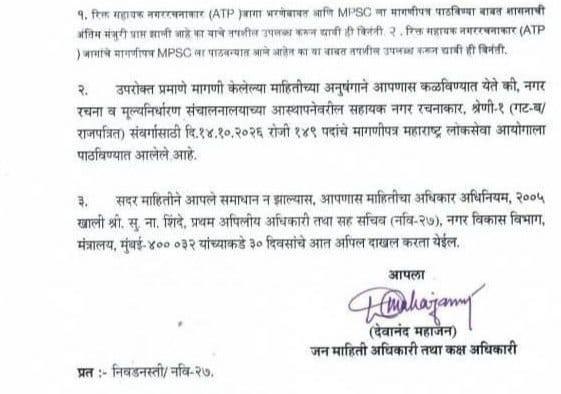
MPSC published the revised recommendation list (Advt. 051/2024, 8 Oct 2026). Requisition for 149 vacancies sent to the MPSC on 14 Oct 2026. Notification date and exam date are unannounced. Use this window to build your base.
Official RTI Reply
MPSC Assistant Town Planner (Group-B): Requisition for 149 Vacancies Sent to MPSC on 14 October 2026
Quick answer: Patrick Geddes is linked with Place-Work-Folk, Survey before Plan, Conservative Surgery, the Outlook Tower and the term Conurbation. Clarence Perry is linked with the Neighbourhood Unit (quarter-mile walk) and Clarence Stein with Radburn.

Watch the full free Demo Lecture 2 on YouTube
· More free MPSC ATP demo lectures
This post summarises the second free demo lecture of the MPSC ATP 2027 batch, taught live on 24 October 2026. It follows the Garden City concept from Demo Lecture 1. Planning Theories is the best first topic because it builds the vocabulary the MR&TP Act and UDCPR depend on; the full order is in the MPSC ATP preparation strategy.
Sir Patrick Geddes: not one concept, seven
The syllabus may say only "Geddes' triad", but the lecture stresses that Geddes gave seven concepts and all are exam material. His Region concept came first, and it fed into the Bombay Town Planning Act of 1915. He is also taught as the Father of Town Planning, which has been asked as an MCQ.
| Concept | What to remember |
|---|---|
| Place-Work-Folk | Place = environment (land, topography, climate), Work = function (economic activity, occupation), Folk = organism (the people). Every human settlement depends on these three. |
| Survey before Plan | Diagnosis before treatment. Survey the physical (topography, roads, buildings, infrastructure), social, economic, environmental (water bodies, pollution) and historical (monuments, traditions) conditions, then plan. |
| Conservative Surgery | Improve the existing urban area with small, selective, careful interventions instead of demolishing and rebuilding. Demolition is not the option; improvement is. |
| Outlook Tower | Built in the centre of Edinburgh: a tall building from which people could see the whole city, give suggestions and learn about their city. It stands for public participation, which is why plans today invite suggestions and objections. |
| Valley Section | Where you live (coast, hills, plains) shapes your occupation and economic activity. |
| Conurbation | A city grows so much that neighbouring villages and towns merge into one continuous urban area. Geddes discussed it in Cities in Evolution. |
Conurbation, urban agglomeration, polycentric. The internationally common word today is urban agglomeration. If both words appear in an MCQ for Geddes' concept, tick Conurbation. In a polycentric urban agglomeration there are many centres, not one CBD: Mumbai has South Mumbai, Andheri and others, each with its own centre, though people still depend on the older centre for higher-level amenities.
People first. Geddes held that a city exists because of its people, not its infrastructure. Infrastructure grows where people come, so planning must put people and social life first. Geddes also visited India and advised on improving towns, which fed into the Bombay Town Planning Act of 1915.
Clarence Perry: the Neighbourhood Unit
Perry was an American planner. Traffic was growing and children could no longer play on roads or cross them safely, so he proposed a residential unit where the daily needs are found inside the neighbourhood.
- Size: small, about 5,000 to 9,000 people (as stated in the lecture).
- Boundary: major roads on all four sides, so adjoining neighbourhood units can connect.
- Inside: an interior street pattern that discourages through traffic (cul-de-sacs are an example), with the school, community centre, green space and small shopping all within the unit.
- Walking distance: everything within a quarter-mile (one-fourth mile) radius, about a 5-minute walk. Children walk to the elementary school with no fast-moving traffic to cross.
- Principle to remember: the neighbourhood shopping centre should not be at the edge on the major road; major arterial through traffic should not pass through the residential neighbourhood.
Clarence Stein and Radburn. Between the garden city and the neighbourhood unit, Clarence Stein designed Radburn, New Jersey: a combination of both ideas using superblocks. It is not a perfect circle like the garden city, but it provides greenery and discourages through traffic. Remember the planner: Radburn is by Stein.
Limitations today
- Low-density planning is not possible when population is growing and land is scarce.
- In India you cannot insist that every child attends the school in their own neighbourhood: boards (ICSE, CBSE), higher education, arts or commerce all need different schools.
- One community centre and one garden per unit assumes everyone is served by their own neighbourhood, which does not match how cities work now.
Four planners, four ideas
| Planner | Concept |
|---|---|
| Patrick Geddes | Place-Work-Folk, Survey before Plan, Conservative Surgery, Outlook Tower, Valley Section, Conurbation |
| Ebenezer Howard | Garden City (not Geddes; the satellite town is not Geddes either) |
| Clarence Stein | Radburn, New Jersey |
| Clarence Perry | Neighbourhood Unit |
Practice MCQs
- Place, Work and Folk correspond to? Environment, function, organism.
- Who gave the Garden City concept? Ebenezer Howard, not Geddes.
- Who designed Radburn, New Jersey? Clarence Stein.
- Which approach did Geddes support for a congested old area? Conservative Surgery: improve it, do not demolish it.
- A principle of the Neighbourhood Unit? Interior streets that discourage through traffic, major roads on the boundary, facilities within a quarter-mile.
- Which term describes neighbouring settlements merging into a continuous urban area? Conurbation.
Tip from the lecture: when you are unsure, remove options that you know are wrong; elimination often gets you the answer. In the batch, each topic ends with MCQs, and a workbook PDF shows what points to note so you build your own notes, alongside the hardcopy notes and flashcards. Solve past-paper MCQs from the free PYQ papers straight after the topic.
The MPSC ATP 2027 online batch
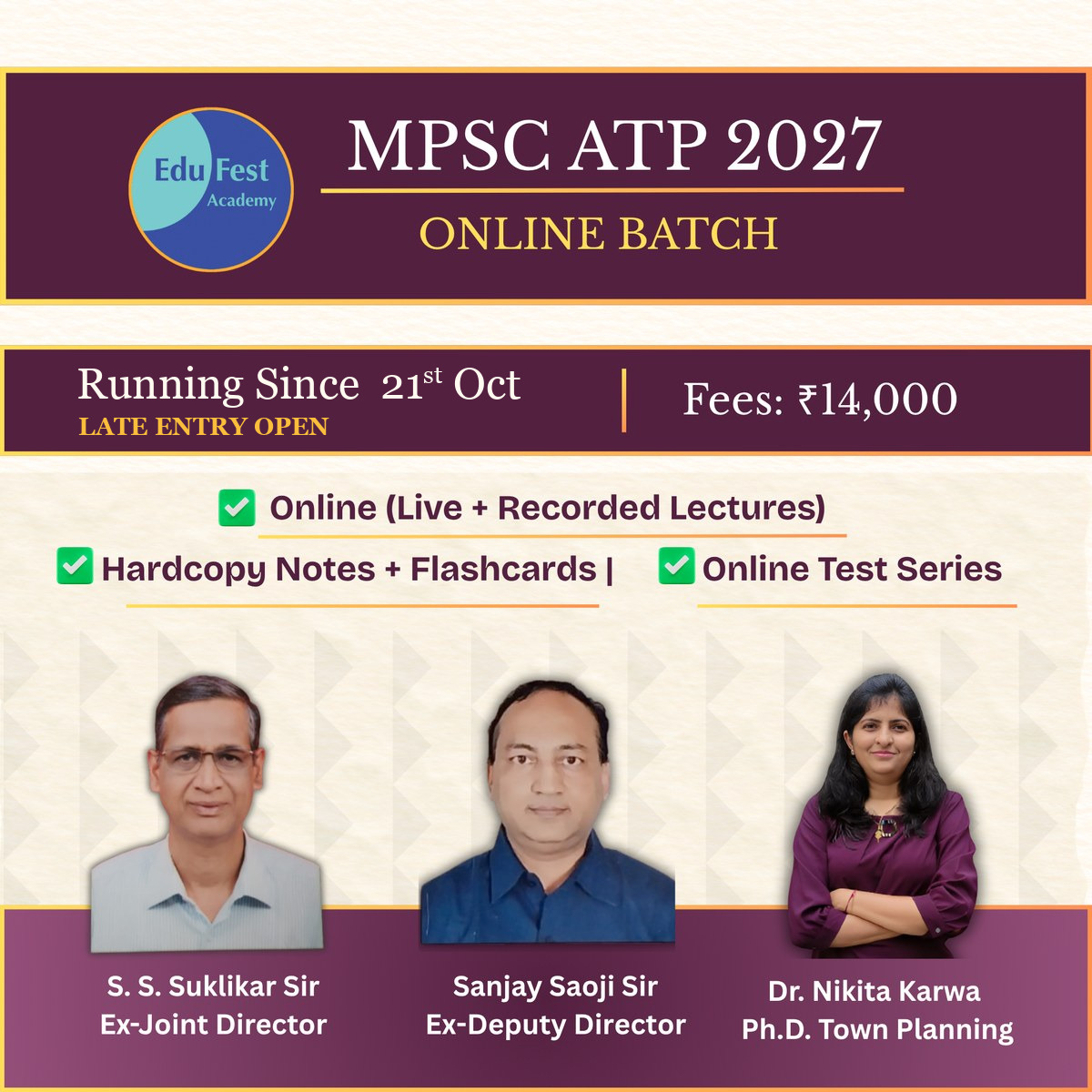
Live lectures every Wednesday and Saturday, with recordings, topic PDFs and MCQ practice. Fee Rs 14,000, payable in two instalments of Rs 7,000; old students get a 25% discount.
See the MPSC ATP 2027 Online Batch →
FAQs
What is Place-Work-Folk?
Patrick Geddes' triad: place is the environment, work is the function (economic activity) and folk are the organism (the people). A settlement depends on all three.
Who designed Radburn, New Jersey?
Clarence Stein, combining the garden city and neighbourhood ideas using superblocks.
What is Conservative Surgery?
Geddes' approach of carefully improving old congested areas instead of demolishing them.
What is the Neighbourhood Unit concept?
Clarence Perry's idea of a unit of about 5,000 to 9,000 people with schools, parks and daily facilities within a quarter-mile walk, major roads on its boundary and interior streets that discourage through traffic.