MPSC ATP: 148 recommended in revised list, next advertisement awaited
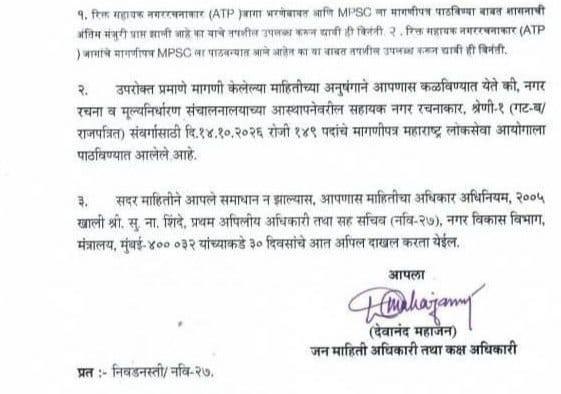
MPSC published the revised recommendation list (Advt. 051/2024, 8 Oct 2026). Requisition for 149 vacancies sent to the MPSC on 14 Oct 2026. Notification date and exam date are unannounced. Use this window to build your base.
Official RTI Reply
MPSC Assistant Town Planner (Group-B): Requisition for 149 Vacancies Sent to MPSC on 14 October 2026
By EduFest Academy, based on a lecture by Sanjay Saoji Sir, Retd. Deputy Director of Town Planning, Maharashtra ·
Most guides to the MPSC Assistant Town Planner (ATP) exam stop at the syllabus. This one starts with the job. It is based on a 33-minute lecture by Sanjay Saoji Sir, who spent about 40 years in Maharashtra's Town Planning & Valuation Department, from Planning Assistant to Deputy Director, including postings as Under Secretary and Deputy Secretary in Mantralaya. Below, we turn that lecture into a practical guide: what the department is, where an ATP is posted, how the exam works, which parts score most, and how to start preparing.
- What the post is: Assistant Town Planner, Grade-I (Group-B, Gazetted), Maharashtra Town Planning and Valuation Service, recruited directly by MPSC.
- Who can apply: Architecture and B.E. Civil graduates have both been eligible so far, and Saoji Sir says no change has been ordered. Always confirm in the new advertisement.
- Exam: 100 objective questions, 2 marks each (200 marks), 60 minutes, online, in English, then a 50-mark interview.
- Where you work: municipal corporations and councils, district town planning offices, development authorities (PMRDA, NMRDA, MSRDC, SRA), the valuation wing and land acquisition.
- Most scoring areas, per Saoji Sir: UDCPR, land acquisition and valuation.
- Next exam: 149 vacancies; requisition sent to MPSC on 14 Oct 2026; advertisement awaited.
Who is explaining this: Sanjay Saoji Sir
Sanjay Saoji Sir is a retired Deputy Director of Town Planning, Maharashtra (M.Tech, Town and Country Planning; B.E. Civil). In the lecture he describes working in almost every post of the department, from Planning Assistant up to Deputy Director, and in Mantralaya as Under Secretary and Deputy Secretary. He has:
- prepared Development Plans and Regional Plans, and handled their approval at Mantralaya;
- worked extensively on UDCPR (Unified Development Control and Promotion Regulations);
- been in service when the Pune DCPR 2017 was approved and when PMRDA was established;
- worked on GIS-based Development Plans and drafted many Government Resolutions (GRs).
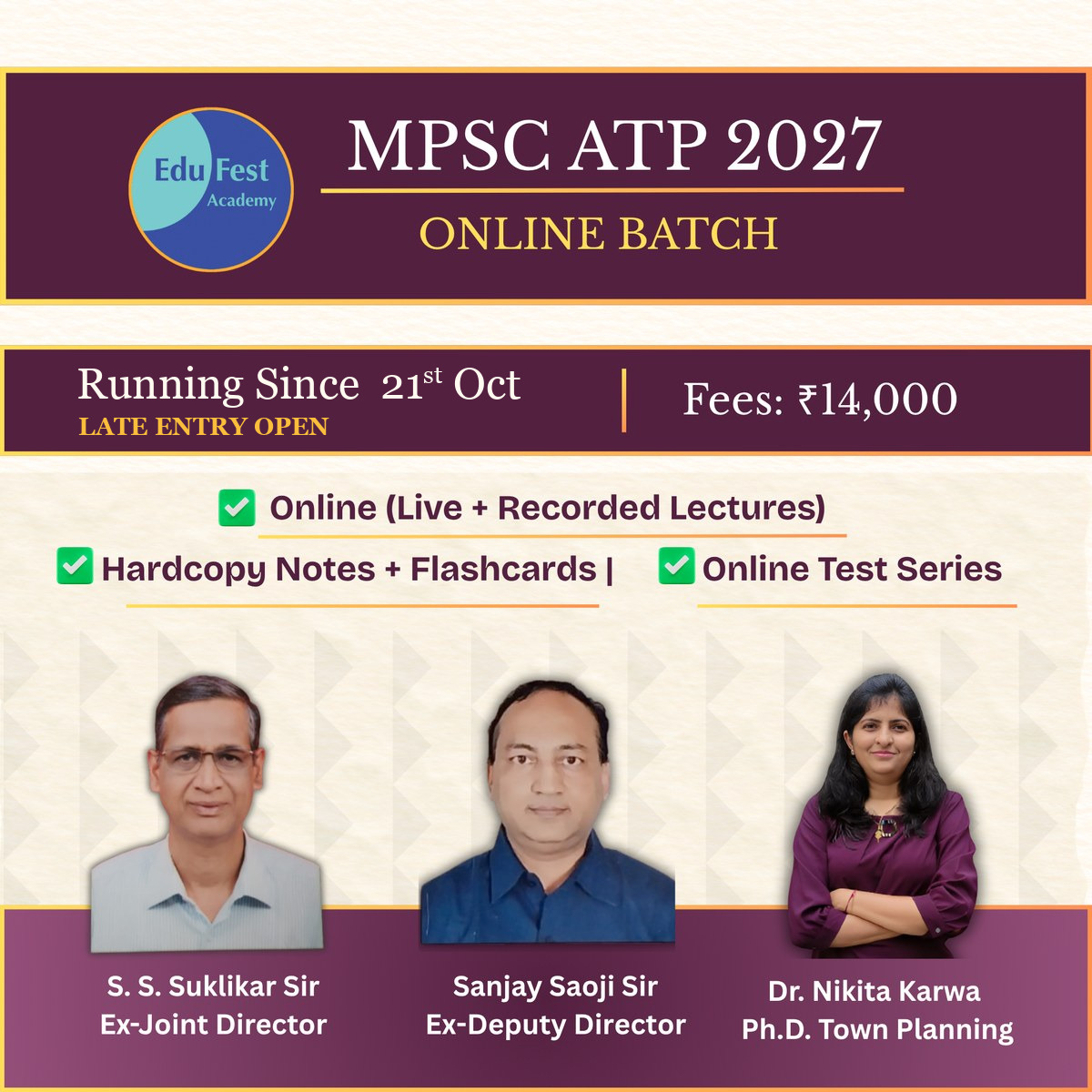
He now teaches the MPSC ATP batch at EduFest Academy with S. S. Suklikar Sir (Retd. Joint Director, about 40 years' experience) and Dr. Nikita Karwa (Ph.D., town planning).
What is the Town Planning & Valuation Department?
The department dates back to British times. It began in 1914 as the Consulting Surveyor to Government and has been headed by the Director of Town Planning since 1962. Today it sits under the Urban Development Department of the Government of Maharashtra.
Saoji Sir's point for aspirants: the department used to be mostly about preparing Development Plans. It is now multi-functional. An ATP may plan, regulate, value land or acquire it, depending on the posting. That variety is what makes the job challenging, and it is also why the syllabus covers 19 different topics.
Department hierarchy at a glance
| Level | Who sits there |
|---|---|
| Government | Principal Secretary, Urban Development Department (UD-1 handles town planning; UD-2 handles municipal bodies) |
| Directors (5 posts) | Director of Town Planning, Maharashtra (Pune); a Director in Mantralaya as Joint Secretary; Directors of Town Planning at MIDC, MSRDC and the MMR region |
| Joint Directors | One for each of the six revenue divisions: Pune, Konkan, Nashik, Chhatrapati Sambhajinagar (Aurangabad), Amravati and Nagpur; plus the Joint Director of Valuation for the whole state |
| District and branch level | Town planning offices, land acquisition offices and urban land ceiling offices |
| Special planning authorities | PMRDA and other regional development authorities (Chhatrapati Sambhajinagar, Nagpur, Nashik, MMR) |
| Urban local bodies | Every municipal corporation and council has posts from Assistant Town Planner up to Deputy Director |
Because new municipal bodies and planning authorities keep being created, the number of posts keeps growing, and these posts are filled by direct recruitment through MPSC.
What does the department do?
The department's objectives, as shown in the lecture:
- plan development in non-urban areas through Regional Plans;
- plan development in urban areas through Development Plans;
- implement Development Plan proposals on specific land parcels through Town Planning Schemes (TPS);
- advise the government on legal and technical town planning matters under the Maharashtra Regional and Town Planning (MR&TP) Act, 1966;
- ensure land is developed in a structured, regulated way in urban local bodies through DCPRs.
Its main functions include preparing Regional Plans (through the Regional Planning Board), Development Plans and Town Planning Schemes; advising on Integrated Township Projects and MR&TP Act matters; transportation plans and junction designs; layouts on government land for rehabilitation; acting as the expert on land valuation and land acquisition; and helping the Registration Department prepare the Annual Statement of Rates (ready reckoner rates) used for stamp duty.
Where an Assistant Town Planner can be posted
This is the question most new graduates ask. Saoji Sir lists five kinds of posting, and earlier selected candidates are working in all of them:
| Posting | What you actually do |
|---|---|
| Municipal councils and corporations (on deputation) | Advise on planning, implement the DP and TPS, scrutinise building permissions and layouts, issue occupancy certificates, act on unauthorised construction |
| District and branch town planning offices | Prepare DPs and TPS, scrutinise modification proposals, advise the Collector on permissions in Regional Plan areas, scrutinise draft land acquisition awards |
| Development authorities (on deputation) | PMRDA, NMRDA, MSRDC, SRA, Maritime Board: prepare plans, grant development permissions, implement the Development Plan |
| Valuation wing, with the Registration Department | Prepare the Annual Statement of Rates for stamp duty; handle adjudication and appeal proposals |
| Land acquisition | Prepare acquisition proposals as per the Development Plan; town planners declare awards and hand over possession as acquisition officers |
Saoji Sir also notes that town planners are now needed across government: Revenue, Urban Land Ceiling, Public Works and Environment all rely on the department's expertise.
Career growth: how far can an ATP go?
The department has a clear ladder: Assistant Town Planner → Town Planner → Assistant Director → Deputy Director → Joint Director → Director. Saoji Sir's own career, from Planning Assistant to Deputy Director with time in Mantralaya, shows how far the cadre can take you, and how varied the work becomes as you rise: plan preparation, plan approval, regulations, and policy.
After selection: every selected candidate goes through about one month of compulsory training at YASHADA, Pune, at government expense. So you don't need to be an expert on every one of the 19 topics on day one. The exam checks your foundation, and the department trains you further.
Eligibility, age and pay
- Qualification: Architecture and B.E. Civil graduates have both been eligible in past advertisements. Saoji Sir says no government order changing this has been issued.
- Age limit: 18–38 years in the 2024 advertisement (as on 1 Feb 2025), with relaxation for reserved categories.
- Pay: the 2024 advertisement placed the post in pay scale S-15 (₹41,800–₹1,32,300) plus allowances.
All three can change, so confirm them in the official MPSC advertisement when it is published.
MPSC ATP exam pattern
| Stage | Details |
|---|---|
| Written exam | 100 objective questions × 2 marks = 200 marks |
| Time | 60 minutes (about 36 seconds per question) |
| Mode and medium | Online (as in past exams), English |
| Interview | 50 marks |
| Final merit | Written + interview |
Speed matters. Reading 100 questions and their options in 60 minutes is hard, so Saoji Sir advises studying in a way that lets you recognise the right option immediately, and practising full-length timed papers.
How the interview is marked: the panel divides the 50 marks across your presentation, subject knowledge, extracurricular profile and communication skills.
The syllabus: 19 topics in five blocks
The syllabus has 19 topics, and Saoji Sir expects it to stay the same. EduFest groups them into five blocks (see the topic-wise syllabus guide for every sub-topic):
| Block | Topics | Saoji Sir's note |
|---|---|---|
| A. General Planning | Current events and technology (GIS, GPS, remote sensing, drones), urbanisation and government schemes, policies, RTI and RTS Acts, theories of planning | 2–4 questions per part; know urbanisation trends, migration and current planning ideas such as urban growth hubs |
| B. Plan-Making | Regional Plan, Development Plan, Town Planning Scheme, Local Area Plan | The department's core; many questions come from here |
| C. Regulation | UDCPR, development charges and appeals | Students' favourite and the most scoring part |
| D. Infrastructure and Law | Transportation, environment, MR&TP Act, Maharashtra Municipal Corporations Act, Municipal Councils Act, Maharashtra Land Revenue Code, Environment Protection Act, Bombay Stamp Act, 73rd and 74th Amendments | Study each Act only to the depth an ATP uses it |
| E. Land and Valuation | Land acquisition (RFCTLARR Act, 2013), valuation, valuation tables, methods of valuation, Annual Statement of Rates | Land acquisition and valuation are very scoring |
How to start preparing: Saoji Sir's advice
- Start early. The advertisement can come with little notice, and the syllabus is wide, so starting before the notification gives you the most study time.
- Understand the department, not just the bare acts. Questions make more sense when you know why a rule exists and how the office applies it.
- Lock in the scoring blocks first: UDCPR, land acquisition and valuation.
- Train for speed. Take timed mock tests of 100 questions in 60 minutes.
- Revise with visuals. Short visual notes and flashcards help you recall definitions (for example, carpet area) quickly in the exam hall.
- Respect the competition. In past selections candidates have missed out by one or two marks, and everyone in the race is capable. Small gains in accuracy decide the list.
For a full study sequence, read our MPSC ATP preparation strategy for 2027.
Latest status: when is the next MPSC ATP exam?
As of 2 Nov 2026, the Urban Development Department says the requisition for 149 Assistant Town Planner posts was sent to MPSC on 14 October 2026. No advertisement or exam date has been announced yet. Details: 149 vacancies sent to MPSC (requisition, 14 Oct 2026). The last recruitment (Advt. 051/2024) ended with a revised list of 148 candidates.
Watch the full lecture
The complete 33-minute lecture (in Marathi, with slides in English) is on the EduFest Academy YouTube channel. Jump straight to a section:
- 0:00 Introduction: Sanjay Saoji Sir
- 4:59 Town Planning & Valuation Department
- 5:24 Department structure and hierarchy
- 7:54 Objectives of the department
- 10:25 Functions of the department
- 10:50 Where an Assistant Town Planner can be posted
- 11:23 Exam pattern (and Saoji Sir's career story)
- 14:19 Syllabus: General Planning and Plan-Making
- 19:20 Syllabus: UDCPR and development charges
- 20:17 Syllabus: Infrastructure, Law, Land and Valuation
- 24:20 MPSC ATP 2027 Online Batch: details and faculty
Prepare with the people who did the job
EduFest Academy's MPSC ATP 2027 Online Batch is taught in-house by retired department officers and a town planning Ph.D.:
- live and recorded lectures in Marathi and English;
- the academy's own books, updated whenever the MR&TP Act or UDCPR changes;
- hardcopy notes and a flashcard box with visual explanations;
- an online test series built in the real 100-questions-in-60-minutes format.
Watch free demo lectures · Get the free MPSC ATP companion PDF · WhatsApp: 7709585248
मराठीत सारांश
सहायक नगर रचनाकार (ATP) हे महाराष्ट्र नगर रचना व मूल्यनिर्धारण सेवेतील गट-ब (राजपत्रित) पद असून त्याची थेट भरती MPSC मार्फत होते. नगर रचना विभागाचे निवृत्त उपसंचालक श्री. संजय साओजी सर यांच्या मते आता हा विभाग बहुउद्देशीय (multi-functional) झाला आहे. निवड झाल्यावर तुमची नियुक्ती महानगरपालिका, नगरपालिका, जिल्हा नगर रचना कार्यालय, PMRDA, NMRDA, SRA, मूल्यांकन विभाग किंवा भूसंपादन विभागात होऊ शकते.
लेखी परीक्षा २०० गुणांची असते (१०० प्रश्न, प्रत्येकी २ गुण, ६० मिनिटे, इंग्रजी माध्यम) आणि त्यानंतर ५० गुणांची मुलाखत होते. अभ्यासक्रमात १९ विषय आहेत. त्यापैकी UDCPR, भूसंपादन आणि मूल्यांकन हे भाग सर्वाधिक गुण मिळवून देणारे आहेत. निवड झालेल्या उमेदवारांना यशदा, पुणे येथे एक महिन्याचे सक्तीचे प्रशिक्षण दिले जाते. स्पर्धा कडवी आहे, कारण अनेकदा एक-दोन गुणांच्या फरकाने निवड ठरते. म्हणून लवकर अभ्यास सुरू करा आणि वेळ लावून सराव परीक्षा द्या.
Frequently asked questions
What does an MPSC Assistant Town Planner do?
An Assistant Town Planner works in Maharashtra's Town Planning & Valuation Department. Depending on the posting, the work includes preparing Development Plans and Town Planning Schemes, scrutinising building permissions and layouts in municipal bodies, granting development permissions in authorities like PMRDA, preparing ready reckoner rates in the valuation wing, and handling land acquisition.
Where is an MPSC Assistant Town Planner posted?
In municipal corporations and councils (on deputation), district and branch town planning offices, development authorities such as PMRDA, NMRDA, MSRDC and SRA, the valuation wing with the Registration Department, and land acquisition offices.
Who is eligible for MPSC ATP?
In past advertisements both Architecture and B.E. Civil graduates were eligible, with an age limit of 18–38 years (2024 advertisement) and relaxation for reserved categories. Confirm the exact eligibility in the next official MPSC advertisement.
What is the MPSC ATP exam pattern?
A 200-mark online objective exam (100 questions × 2 marks, 60 minutes, English), followed by a 50-mark interview. The final merit list combines both.
How many topics are in the MPSC ATP syllabus?
19 topics, grouped as General Planning, Plan-Making, Regulation (UDCPR), Infrastructure and Law, and Land and Valuation.
Which part of the MPSC ATP syllabus is most scoring?
According to Sanjay Saoji Sir, UDCPR is the most scoring part, followed by land acquisition and valuation.
What is the salary of an MPSC Assistant Town Planner?
In the 2024 advertisement the post was in pay scale S-15 (₹41,800–₹1,32,300) plus allowances. Check the new advertisement for current figures.
Is there training after selection as an MPSC ATP?
Yes. Selected candidates receive about one month of compulsory training at YASHADA, Pune, at government expense.
When is the next MPSC ATP exam?
The Urban Development Department says it sent the requisition for 149 vacancies to MPSC on 14 October 2026. The advertisement and exam date are still awaited.
Sources
- Lecture by Sanjay Saoji Sir, Retd. Deputy Director of Town Planning, Maharashtra, EduFest Academy YouTube channel (1 Nov 2026): https://www.youtube.com/watch?v=l-g5zB9f_l0
- MPSC scheme of examination, Assistant Town Planner Grade-I (Group-B): mpsc.gov.in
- MPSC Advertisement 051/2024 (age limit and pay scale), mpsc.gov.in
- EduFest Academy: 149 ATP vacancies, requisition sent to MPSC